

For today’s CTOs and CIOs, the pressure to deliver actionable data insights within your products has never been higher. However, a critical dilemma often stalls your progress toward the business intelligence tools you need for the task: Should your engineering team build a bespoke analytics engine from scratch, or should you integrate a professional embedded solution? While the "build it" route offers the allure of total control, it frequently descends into a maintenance trap that drains your resources and delays - or even thwarts - your goals of having something which visualizes your current business position and informs your onward success. In this article, we will explore the contentious tradeoffs between these two paths, arguing that for leaders prioritizing scalability, security, and ROI, embedding a professional-grade solution is the superior strategic move.
 Handling Multi-Tenant Complexity Without Refactoring
Custom builds often struggle with "data model explosion", where adding new tenants requires manual engineering intervention. This creates performance degradation and latency spikes that alienate your decision-makers. Specialist platforms are designed for cloud-native environments, utilizing techniques such as containerization to scale seamlessly without requiring a total refactoring of your host application.
Inherited Security and Governance
Building your own custom solution exposes your application to custom vulnerabilities. In regulated industries, the risks are even higher. Embedded solutions allow you to "inherit" the vendor’s security posture. By using self-hosted embedded options, you keep data within your own environment while benefiting from the vendor's rigorous compliance standards and isolation protocols. It also helps offload the compliance burden by having the vendor deal with much of it, an area in which they specialize.
Beyond Iframes: Achieving Pixel-Perfect Integration
Many leaders fear that "buying" means sticking an ugly, third-party iframe into your elegant UI. This is a myth. Yellowfin’s SDK-driven embedded analytics provide pixel-perfect, white-labeled integration with full control over the look so it integrates perfectly, both visually and conceptually. This allows the analytics to match your design language exactly, providing a seamless experience that feels entirely native to your end-user.
Empowering End-Users with True Self-Service
A common pitfall of custom builds is "bottlenecking." Your users are restricted to predefined views, forcing them to submit tickets to data analysts for new queries and views. Professional embedded solutions like Yellowfin provide drag-and-drop self-service capabilities directly within your app. This can boost your user engagement because users can find their own answers without ever leaving your platform. As organizations increasingly invest in analytics literacy and even encourage teams to enroll in the best data science course programs to strengthen internal expertise, providing intuitive embedded tools ensures that newly developed skills can be applied immediately within your product ecosystem.
Handling Multi-Tenant Complexity Without Refactoring
Custom builds often struggle with "data model explosion", where adding new tenants requires manual engineering intervention. This creates performance degradation and latency spikes that alienate your decision-makers. Specialist platforms are designed for cloud-native environments, utilizing techniques such as containerization to scale seamlessly without requiring a total refactoring of your host application.
Inherited Security and Governance
Building your own custom solution exposes your application to custom vulnerabilities. In regulated industries, the risks are even higher. Embedded solutions allow you to "inherit" the vendor’s security posture. By using self-hosted embedded options, you keep data within your own environment while benefiting from the vendor's rigorous compliance standards and isolation protocols. It also helps offload the compliance burden by having the vendor deal with much of it, an area in which they specialize.
Beyond Iframes: Achieving Pixel-Perfect Integration
Many leaders fear that "buying" means sticking an ugly, third-party iframe into your elegant UI. This is a myth. Yellowfin’s SDK-driven embedded analytics provide pixel-perfect, white-labeled integration with full control over the look so it integrates perfectly, both visually and conceptually. This allows the analytics to match your design language exactly, providing a seamless experience that feels entirely native to your end-user.
Empowering End-Users with True Self-Service
A common pitfall of custom builds is "bottlenecking." Your users are restricted to predefined views, forcing them to submit tickets to data analysts for new queries and views. Professional embedded solutions like Yellowfin provide drag-and-drop self-service capabilities directly within your app. This can boost your user engagement because users can find their own answers without ever leaving your platform. As organizations increasingly invest in analytics literacy and even encourage teams to enroll in the best data science course programs to strengthen internal expertise, providing intuitive embedded tools ensures that newly developed skills can be applied immediately within your product ecosystem.
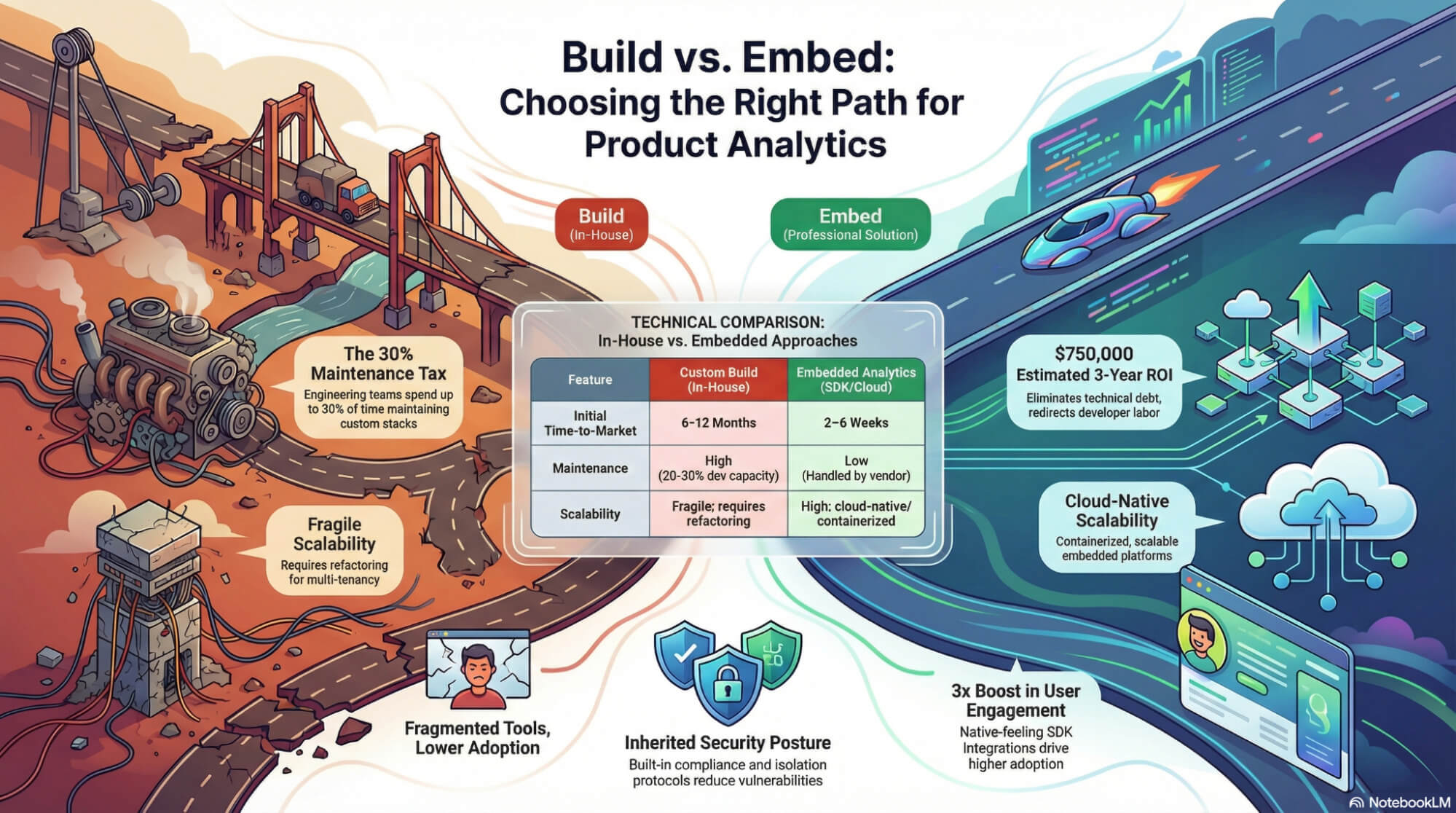 Quantifying the Maintenance Trap
In-house tools demand perpetual data engineering for schema changes, leading to roughly 40% higher long-term costs. When you factor in staff retention, the cost of losing the one developer who knows how your “custom” engine works, the "build it yourself" strategy becomes a high-risk liability.
Predictable Pricing vs. Exploding Overheads
The ROI of embedding analytics can be achieved by eliminating the need for context-switching and saving approximately $50,000 per developer annually in redirected labor. Embedded solutions offer fixed, predictable pricing that prevents the "budget creep" associated with constant feature requests and scaling issues.
Quantifying the Maintenance Trap
In-house tools demand perpetual data engineering for schema changes, leading to roughly 40% higher long-term costs. When you factor in staff retention, the cost of losing the one developer who knows how your “custom” engine works, the "build it yourself" strategy becomes a high-risk liability.
Predictable Pricing vs. Exploding Overheads
The ROI of embedding analytics can be achieved by eliminating the need for context-switching and saving approximately $50,000 per developer annually in redirected labor. Embedded solutions offer fixed, predictable pricing that prevents the "budget creep" associated with constant feature requests and scaling issues.
Speed to Insight: The Opportunity Cost of Custom Development
The most immediate friction point in the build-vs-buy debate is the "Time-to-Market" (TTM) gap. As a leader, it is easy to underestimate the sheer complexity of building a visualization layer that is both performant and user-friendly. From Months to Weeks: Accelerating Time-to-Market A custom analytics build typically requires 6 to 12 months of initial development. This isn't just a delay; it is a massive diversion of your resources away from your core activities. Conversely, modern embedded analytics solutions deploy in a fraction of the time, often within weeks, using robust SDKs that allow you to build on only those elements which are fundamentally unique to your circumstances. This allows your team to focus on your unique value propositions rather than reinventing the fundamental core of the analytics reporting and dashboarding solution. Eliminating the Iterative Roadmap Bottleneck It’s a reality that analytics are never "finished". As your users adopt your chosen solution and begin to understand it, it can lead them to demand more complex data models and new visualizations. Your team could easily spend as much as 20–30% of their ongoing development time simply maintaining the analytics stack. By choosing to embed, you offload the burden of feature parity, evolution, and iterative updates to a specialist vendor, ensuring your roadmap remains clear for true innovation.Architectural Integrity: Scalability and Security in a Multi-Tenant World
For SaaS providers, the steep challenges of multi-tenancy is often the area where homegrown solutions fail. Scaling a custom-built system to handle thousands of users, each with their own data permissions and schema variations, can quickly become an architectural nightmare.
Handling Multi-Tenant Complexity Without Refactoring
Custom builds often struggle with "data model explosion", where adding new tenants requires manual engineering intervention. This creates performance degradation and latency spikes that alienate your decision-makers. Specialist platforms are designed for cloud-native environments, utilizing techniques such as containerization to scale seamlessly without requiring a total refactoring of your host application.
Inherited Security and Governance
Building your own custom solution exposes your application to custom vulnerabilities. In regulated industries, the risks are even higher. Embedded solutions allow you to "inherit" the vendor’s security posture. By using self-hosted embedded options, you keep data within your own environment while benefiting from the vendor's rigorous compliance standards and isolation protocols. It also helps offload the compliance burden by having the vendor deal with much of it, an area in which they specialize.
Beyond Iframes: Achieving Pixel-Perfect Integration
Many leaders fear that "buying" means sticking an ugly, third-party iframe into your elegant UI. This is a myth. Yellowfin’s SDK-driven embedded analytics provide pixel-perfect, white-labeled integration with full control over the look so it integrates perfectly, both visually and conceptually. This allows the analytics to match your design language exactly, providing a seamless experience that feels entirely native to your end-user.
Empowering End-Users with True Self-Service
A common pitfall of custom builds is "bottlenecking." Your users are restricted to predefined views, forcing them to submit tickets to data analysts for new queries and views. Professional embedded solutions like Yellowfin provide drag-and-drop self-service capabilities directly within your app. This can boost your user engagement because users can find their own answers without ever leaving your platform. As organizations increasingly invest in analytics literacy and even encourage teams to enroll in the best data science course programs to strengthen internal expertise, providing intuitive embedded tools ensures that newly developed skills can be applied immediately within your product ecosystem.
The Hidden Economics of In-House Analytics
The "do it yourself" option often looks cheaper on a spreadsheet because it leverages existing salaries and expenditure patterns. This is an accounting illusion that ignores long-term technical debt and opportunity costs.
Quantifying the Maintenance Trap
In-house tools demand perpetual data engineering for schema changes, leading to roughly 40% higher long-term costs. When you factor in staff retention, the cost of losing the one developer who knows how your “custom” engine works, the "build it yourself" strategy becomes a high-risk liability.
Predictable Pricing vs. Exploding Overheads
The ROI of embedding analytics can be achieved by eliminating the need for context-switching and saving approximately $50,000 per developer annually in redirected labor. Embedded solutions offer fixed, predictable pricing that prevents the "budget creep" associated with constant feature requests and scaling issues.
Real-World Evidence: From Engineering Nightmares to Scalable Success
The shift from building to embedding is best illustrated by looking at organizations that hit the "scalability wall."Conclusion & FAQ
Choosing to build your own analytics often becomes an accidental choice to incur massive technical debt. While the initial control is tempting, the long-term reality involves roadmap delays, security risks, and escalating costs. By contrast, embedded analytics provides a shortcut to a world-class user experience, allowing your team to focus on what you do best: building your core product. Frequently Asked Questions- What are the real long-term costs of building vs. buying? Building front-loads costs in dev time but explodes later due to maintenance (20-30% of dev time) and schema updates. Buying offers a fixed cost with an estimated 3x faster ROI.
- How does embedded analytics handle multi-tenancy? Professional solutions are built for SaaS, processing dynamic data models and tenant-specific fields natively, removing the need for custom engineering marathons.
- Is vendor lock-in a concern? Modern SDKs and open integrations reduce lock-in compared to the "internal lock-in" of a custom build, where only a few developers understand a brittle code base.
- Can embedded analytics match my UI? Yes. Unlike old-fashioned iframe embeds, modern solutions such as Yellowfin offer full white-labeling that matches your application’s design system pixel-for-pixel.
- Is it secure for regulated industries? Absolutely. Self-hosted embedded solutions keep the data within your VPC, inheriting your existing security policies and compliance frameworks.