The data visualization landscape is experiencing a seismic shift. No longer is it enough to simply present dashboards filled with colorful charts and metrics. Today's decision-makers need something more powerful: the ability to understand what their data actually means, why trends are occurring, and what actions to take next. This is where AI-assisted insights in embedded analytics are changing the game.For data professionals and executives steering their companies through increasingly complex business environments, the challenge isn't accessing data—it's extracting meaningful intelligence from it quickly enough to make confident decisions. The good news? Modern embedded analytics platforms are now equipped with sophisticated AI capabilities that transform raw numbers into actionable narratives.
The Growing Demand for Intelligent Embedded Analytics
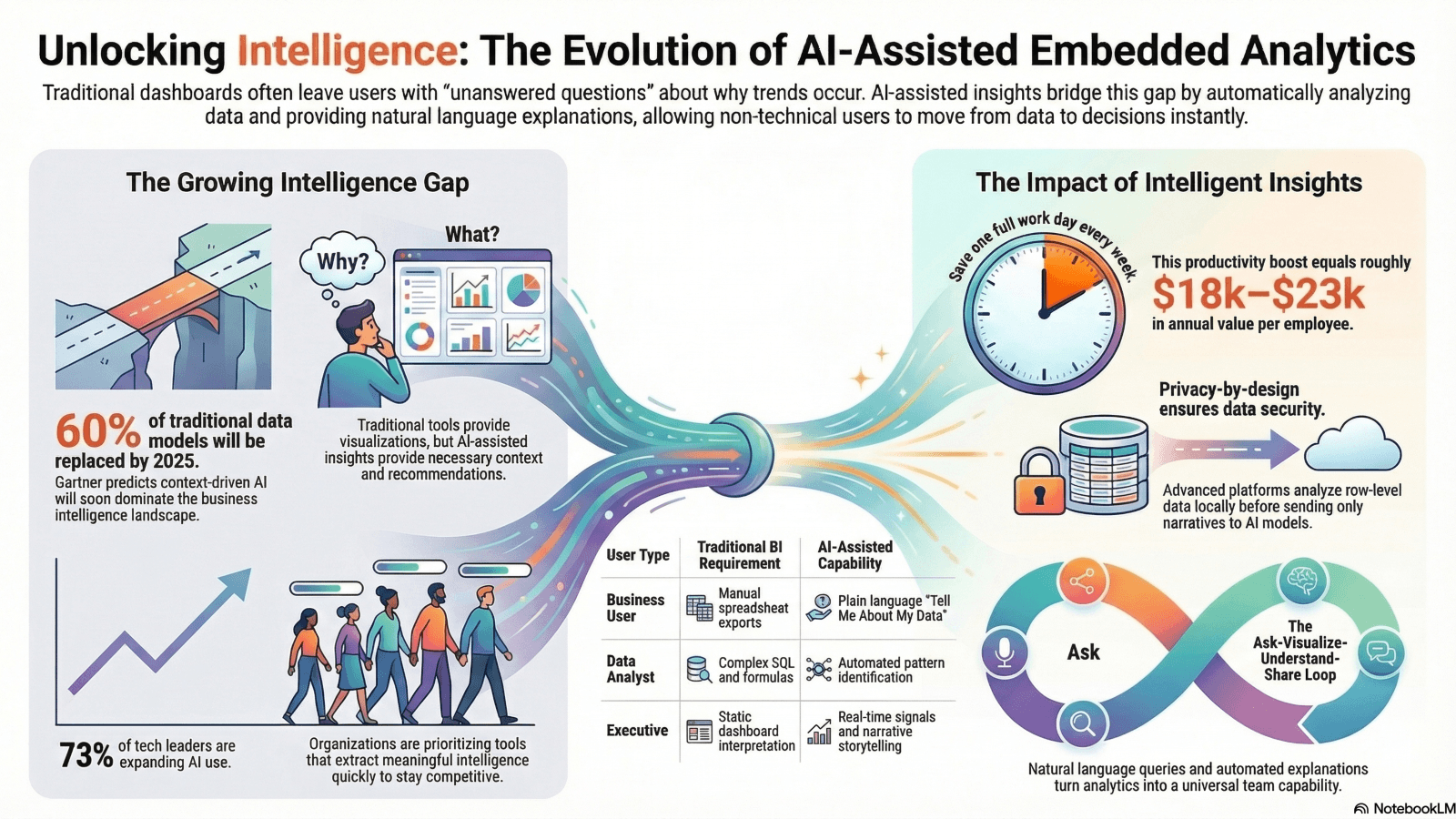
The numbers tell a compelling story. The embedded analytics market is expected to reach $55.54 billion by 2030, reflecting how deeply integrated these tools have become in business applications. More telling is that 73% of tech leaders are planning to expand the use of AI within their organizations in the next year.This surge isn't happening in a vacuum. Business users seem tired of staring at dashboards without understanding the story behind the data. They need context, interpretation, and recommendations—not just visualizations. Traditional analytics tools can leave users with unanswered questions after viewing their reports. AI-assisted insights help answer that question automatically.By 2025, context-driven analytics and AI models will replace 60% of existing models built on traditional data, according to research from Gartner. This transformation reflects a fundamental shift in how people interact with business intelligence tools.
What Makes AI-Assisted Insights Different?
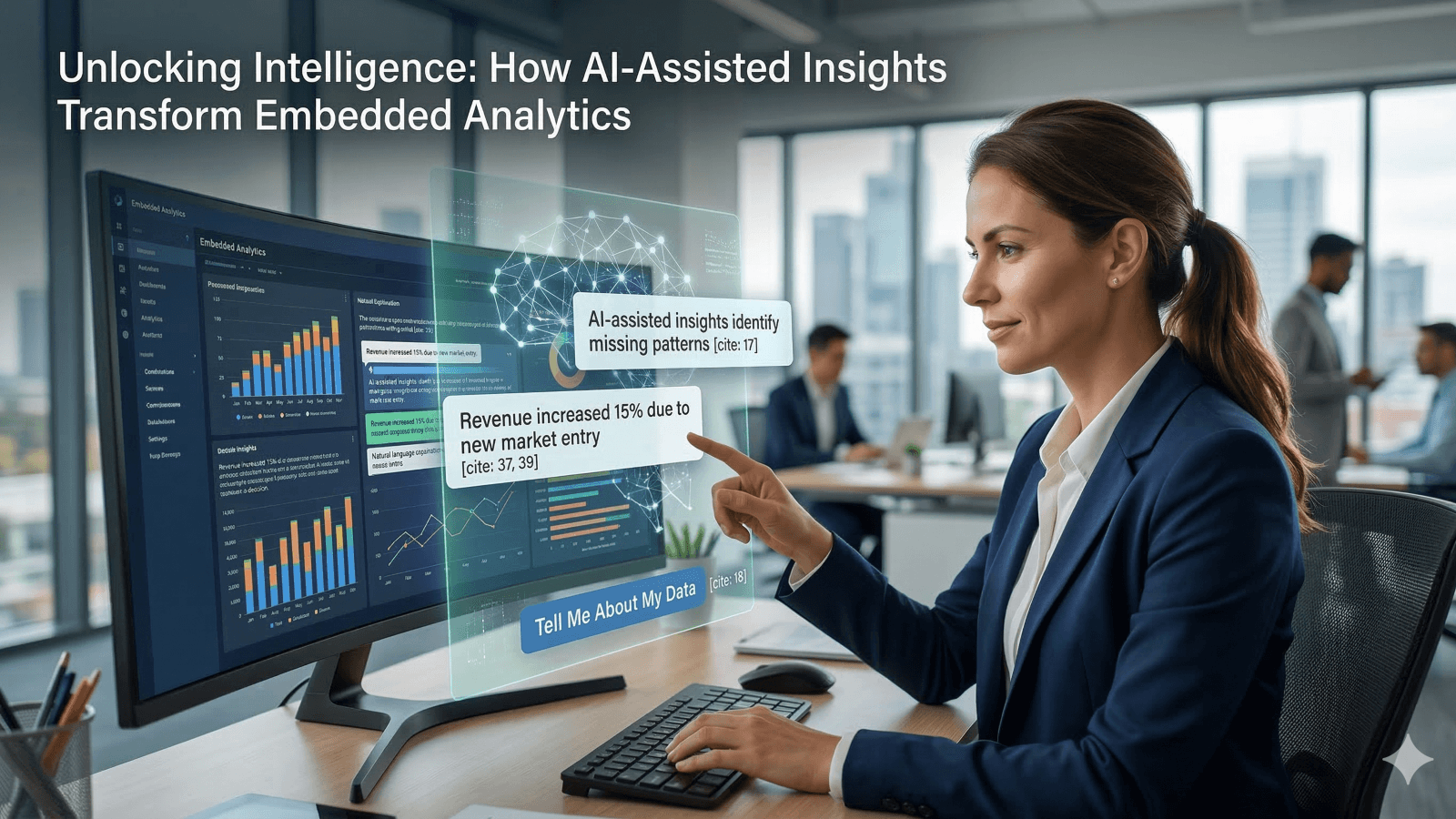
AI-assisted insights go beyond basic automation. They actively analyze your data, identify patterns you might miss, and present their findings in clear, natural language that anyone can understand—regardless of their technical background.Yellowfin's Assisted Insights feature exemplifies this approach. When you're viewing a dashboard or report, you can click a single button to access the "Tell Me About My Data" function. The system automatically processes and analyzes selected data to deliver helpful commentary using clear, natural language explanations and recommended, ready-to-use charts to illustrate its findings.What sets advanced platforms apart is how they handle data security while delivering these insights. Yellowfin's built-in machine learning algorithms first analyze data locally, meaning detailed, row-level data is never transmitted to an external AI model. Only after the initial analysis are insights sent to the AI model for narrative creation. This architecture addresses one of the biggest concerns around AI in analytics: data privacy.
Security Concerns in the AI-Powered Analytics Landscape
The integration of AI into analytics platforms raises legitimate security questions. Organizations face increased exposure to security risks arising from extensive use of embedded BI, including data breaches, unauthorized access, regulatory noncompliance, and unethical data use.Data professionals need to ask tough questions: Where does our data go when AI analyzes it? Who has access to the insights generated? How do we ensure compliance with regulations like GDPR or HIPAA?AI models contain a trove of sensitive data that can prove irresistible to attackers, making robust security architecture non-negotiable. The most responsible platforms implement privacy-by-design principles, ensuring data protection is built into the system from the ground up rather than bolted on afterward.Yellowfin addresses these concerns through several mechanisms. The platform offers native support for leading AI models including Google Gemini, Anthropic Claude, and various OpenAI models, giving organizations the flexibility to choose providers that align with their security standards and compliance requirements. Administrators receive granular token usage information and detailed request auditing, allowing them to monitor AI feature usage and optimize costs while maintaining security oversight.
From Data to Decisions: The Complete Workflow
The real power of AI-assisted insights emerges when they're embedded seamlessly into daily workflows. Consider a typical scenario: a sales executive opens their CRM to check quarterly performance. Instead of spending hours analyzing charts and exporting data to spreadsheets, they can ask questions in plain language.Users can ask questions like "What happened to revenue last quarter?" and instantly get charts and graphs, no SQL required. TheNatural Language Query feature makes data exploration accessible to everyone, not just data analysts.But the workflow doesn't stop at visualization. After generating a chart, users can immediately access AI-generated explanations about what the data reveals. These explanations and charts can be embedded directly into a Story to share compelling, data-driven narratives with teams.This complete loop—Ask, Visualize, Understand, Share—represents a fundamental improvement over traditional business intelligence tools that require users to piece together insights manually across multiple systems.
Making AI Insights Work for Non-Technical Users
One of the most significant barriers to analytics adoption has always been the technical knowledge required to extract value from data. SQL queries, complex formulas, and intricate dashboard configurations kept insights locked away from the people who needed them most.AI-assisted insights break down these barriers. When business users can simply click a button or ask a question in everyday language and receive intelligent, contextualized answers, analytics transforms from a specialist activity into a universal capability.81% of tech leaders noticed a significant increase in interest in Business Intelligence or Embedded Analytics in 2024, driven largely by features that make data accessible without requiring technical expertise. The democratization of data isn't just a buzzword—it's becoming operational reality through AI.Yellowfin's approach recognizes that different users have different needs. Data analysts still have access to advanced report builders with deep functionality. Meanwhile, business users can leverage Quick Charts, Guided Natural Language Query, and AI-powered insights without ever writing a line of code.
The ROI of Intelligent Analytics
The business case for AI-assisted insights extends beyond convenience. Organizations report tangible productivity gains when employees spend less time hunting for answers and more time acting on them.Customers report saving up to a full day every week (equal to $18k–$23k in annual value per employee) using Yellowfin, and that's just measuring time saved. The value of better decisions made faster is harder to quantify but potentially far greater.For software vendors embedding analytics into their applications, companies are creating new income opportunities through analytics-driven offerings, with some seeing verifiable, meaningful business growth. AI-assisted insights become a product differentiator, something that makes your application stickier and more valuable to end users.
Choosing the Right AI Models for Your Needs
Not all AI models are created equal, and different organizations have different requirements around performance, cost, and compliance. The flexibility to choose your AI provider matters.Modern platforms should support multiple AI model options. Yellowfin's support for Google Gemini, Anthropic Claude, and OpenAI models gives organizations choice based on their specific needs. Perhaps your industry requires data to stay within certain geographic boundaries. Maybe your security team has approved specific vendors but not others. Or you might need to optimize for cost versus capability based on usage patterns.Granular token usage information and detailed request auditing allows administrators to monitor usage of AI features as well as optimize costs, providing the visibility needed to make informed decisions about model selection and usage.
Real-World Applications Across Industries
AI-assisted insights prove valuable across diverse use cases. In healthcare, providers embed analytics into electronic health-record screens, bedside monitors, and payer-audit systems to correlate clinical outcomes with reimbursement metrics.Financial services firms leverage embedded analytics for fraud detection, real-time risk scoring, and personalized product recommendations. Manufacturing operations use predictive insights for maintenance scheduling and quality control.The common thread? Each industry benefits from having AI automatically surface the insights that matter most, presented in context when and where decisions get made.
Implementation Considerations
Rolling out AI-assisted insights successfully requires more than just flipping a switch. Organizations need to consider data governance, user training, and change management.Start by identifying the use cases where AI insights will deliver the most value. Perhaps it's helping sales teams understand pipeline changes, or enabling operations managers to spot anomalies before they become problems. Define success metrics upfront so you can measure actual impact.Data quality matters enormously. AI can only be as good as the data it analyzes. Invest time in cleaning and organizing your data sources before expecting AI to extract brilliant insights from messy datasets.For embedded analytics scenarios, think about the end-user experience.Yellowfin's lightweight JavaScript API and secure iframes make it simple to embed dashboards and AI-driven insights directly into applications, ensuring analytics feel like a native part of your product rather than a bolted-on afterthought.
The Future is Intelligent and Embedded
The trajectory is clear: the future points toward ambient intelligence where data processing happens automatically and insights appear exactly when needed. We're moving away from the model where users must actively seek out analytics tools and toward one where intelligent insights surface proactively in the flow of work.This shift has profound implications for how software gets built and how organizations operate. Applications that embed sophisticated AI-driven analytics will have significant advantages over those that don't. Companies that wait too long to adopt these capabilities risk falling behind competitors who have already put intelligent insights into the hands of their teams.The good news? The technology exists today to make this transformation. Only a small fraction of the value that could be unlocked by advanced-analytics approaches has been unlocked (as little as 10% in some sectors), meaning substantial opportunity remains for organizations that act now.
Taking Action
The question isn't whether AI-assisted insights will become standard in embedded analytics—they already are. The question is how quickly your organization can harness these capabilities to drive better decisions and business outcomes.For data professionals evaluating platforms, look for solutions that balance powerful AI capabilities with robust security, flexible model choices, and intuitive user experiences. The right platform should make your job easier, not create new headaches around data governance and compliance.For executives, recognize that investment in intelligent analytics isn't just about better reporting. It's about fundamentally changing how your organization interacts with data, turning every employee into a more effective decision-maker without requiring them all to become data scientists.The embedded analytics market is growing rapidly, and AI-assisted insights are the feature that's driving much of that growth. Organizations that embrace these tools thoughtfully—with attention to security, usability, and real business value—position themselves to thrive in an increasingly data-driven competitive landscape.Yellowfin BI demonstrates how modern platforms can deliver sophisticated AI capabilities while maintaining the security, flexibility, and ease of use that real-world deployments require. Whether you're a software vendor looking to embed analytics into your application or an enterprise seeking better intelligence from your data, the combination of embedded analytics and AI-assisted insights represents a powerful path forward.The data is already there. The question is: are you ready to unlock the intelligence within it?