

Analyse embarquée pour les environnements de données sensibles : comment YellowfinBI aide les équipes à évoluer en toute sécurité sans recruter davantage de personnel
Introduction – Pourquoi les données sensibles rendent l’analyse embarquée plus complexe qu’elle n’y paraît
Les équipes métiers souhaitent disposer d’analyses directement dans l’application qu’elles utilisent déjà. Les services financiers veulent des vues de comptes intégrées aux workflows. Le secteur de la santé a besoin de tableaux de bord opérationnels proches des systèmes patients. Les entreprises réglementées veulent prendre des décisions plus rapidement sans outils supplémentaires. Mais ces mêmes tableaux de bord qui permettent d’agir plus vite peuvent aussi exposer des données personnelles (PII), des données de santé (PHI) et d’autres informations sensibles si l’infrastructure est mal sécurisée. C’est là toute la complexité de l’analyse embarquée dans les environnements traitant des données sensibles.
Pour les CEO, CIO et CTO, le problème ne se limite pas à la sécurité. Il concerne aussi la capacité à évoluer à grande échelle. Si chaque nouveau cas d’usage nécessite un analyste, un administrateur ou un ingénieur en sécurité supplémentaire, l’analytique devient un problème de ressources humaines.
Ce que cet article va couvrir
Cet article définit l’analyse embarquée pour les environnements de données sensibles, identifie les principaux défis en matière de sécurité et de conformité, et explique pourquoi YellowfinBI, grâce à son modèle contrôlé par le client et compatible avec le déploiement on-premises sur yellowfinbi.com, est pertinent pour les équipes qui souhaitent se développer sans augmenter leurs effectifs.
Ce que signifie l’analyse embarquée dans des environnements de données à haut risque
La différence entre le BI embarqué standard et l’intégration de données sensibles
Le BI embarqué standard est principalement une question de commodité. Il s’agit d’intégrer des graphiques dans un portail, de les adapter à l’interface utilisateur et de maintenir les utilisateurs au sein de l’application.
L’intégration de données sensibles a des exigences plus strictes. Elle nécessite la minimisation des données, l’isolation des locataires, la traçabilité (auditabilité), la sécurité au niveau des lignes (row-level security) et le respect de réglementations telles que HIPAA et le RGPD. En d’autres termes, la couche analytique doit se conformer au modèle de confiance de l’application.
Pourquoi l’architecture est plus importante que les tableaux de bord
Le graphique est rarement le problème. Le risque se situe dans le chemin qui alimente ce graphique. Cela inclut l’hébergement, les API, les jetons, les appels à l’IA, les journaux et les jeux de données copiés. Si ces éléments sont mal sécurisés, le tableau de bord devient une fuite de données avec une interface élégante.
C’est pourquoi la position de YellowfinBI sur l’analyse embarquée on-premises est importante. Son modèle maintient la gouvernance au plus près de la source, au lieu de l’ajouter a posteriori. Consultez les recommandations de YellowfinBI dans Embedded BI: Why On-Premises Embedded Analytics Beats Third-Party BI for Data Security.
The Main Risks in Embedded Analytics for Sensitive Data Environments
Data transit, API exposure, and row-level security failures
The first risk is raw data moving through more systems than needed. Every extra hop adds another custody point. Even with encryption, the surface still exists. Misconfigured endpoints, weak token handling, and exposed APIs can turn a simple embed into an open door.
Row-level security can also fail in multi-tenant setups. If filters are off by one rule, users can see records meant for another tenant, another client, or another care team. That is why sensitive environments need controls that sit inside the app trust model, not beside it.
YellowfinBI’s on-premises and customer-controlled hosting model reduces unnecessary transit and keeps sensitive processing near the source. That is a cleaner posture than sending data through a vendor chain.
AI, audit trail, and non-production sprawl risks
A newer risk sits in the AI layer. If AI features can see schema details, query context, or aggregate outputs without tight control, metadata leakage follows. Reveal’s write-up on Security With Embedded Analytics And Its AI Layer makes the point clearly: AI can widen the breach surface if it is not fenced in.
Audit trails matter just as much. If a system cannot show who queried what, when, and from where, compliance review gets messy fast. That gap is painful in finance and healthcare.
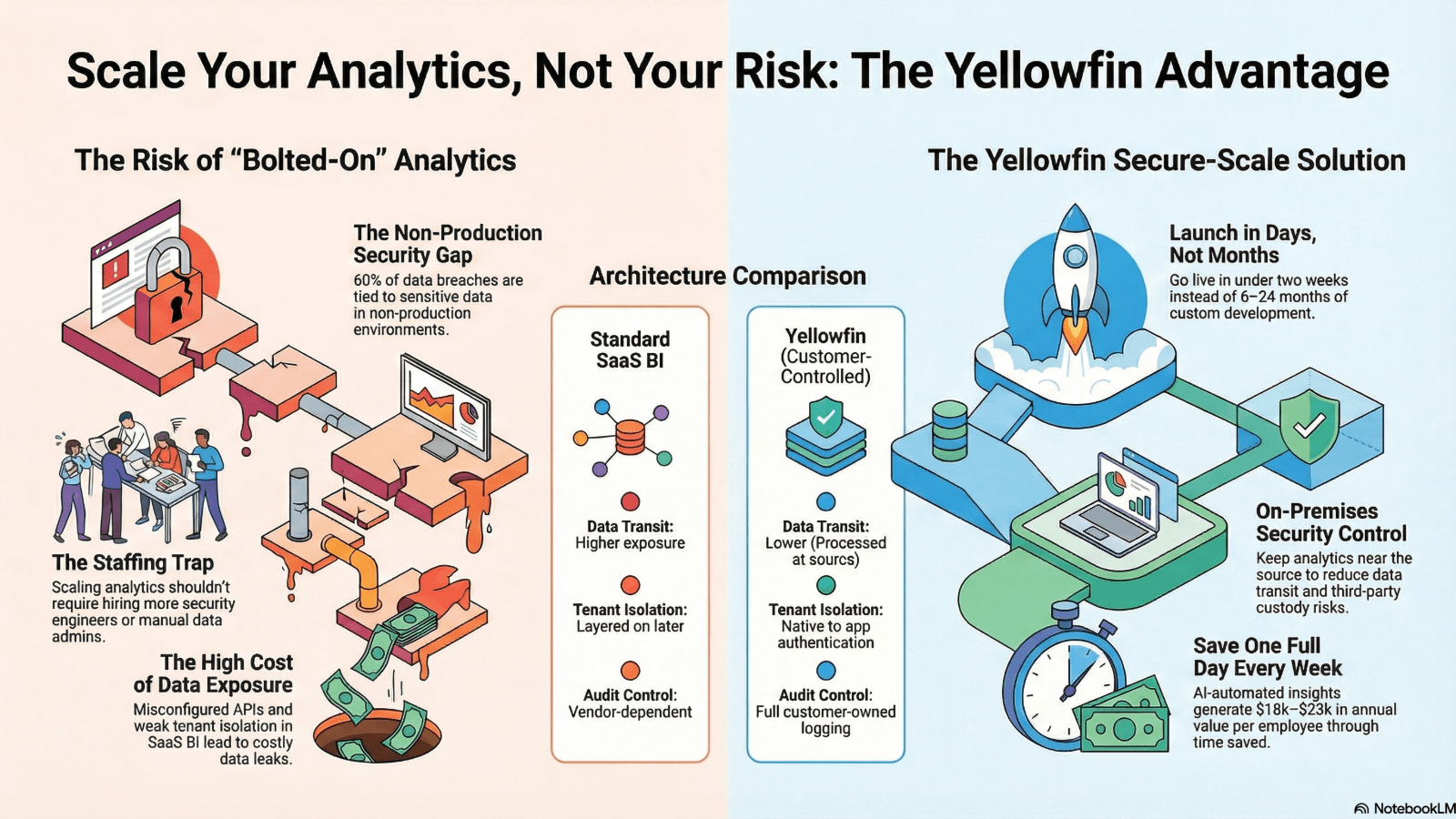
Non-production is another quiet problem. Perforce notes that Protecting Sensitive Data in Non-Production Environments ties data copies in dev and test to major exposure. Their research points to 60 percent of cases seeing breaches or losses tied to sensitive data in non-production, while 54 percent report slower cycles and 45 percent report lower quality from compliance friction. The fix is not more copies. It is in-place masking and tighter analytics workflow controls.
Why Bolted-On BI Often Fails in Regulated Industries
Encryption helps, but it does not fix everything. It does not stop exposed endpoints. It does not stop bad configuration. It does not stop token theft. It does not stop cross-tenant leakage when the app logic is wrong.
That is why the real goal is attack-surface reduction. Sensitive environments need fewer hops, fewer third parties, and fewer blind spots. A bolted-on BI layer often adds the exact problems it was meant to solve.
Why hiring more people is not the scalable answer
Many firms react by hiring more analysts, admins, and security staff. That works for a while, then costs climb and coordination slows. Analytics should not need a growing control room just to stay safe.
A better model gives you built-in governance, inherited app authentication, native policy enforcement, and less need for custom retrofits. That is a leadership call, not just a tooling choice. CEOs, CTOs, and CIOs should ask a simple question: does the analytics layer cut operational drag, or does it add more of it?
YellowfinBI's Security Model for Sensitive Data Environments
On-premises and customer-controlled deployment as the core differentiator
YellowfinBI’s main message is direct. Keep analytics closer to the data and under customer control. That matters for regulated data because it reduces transit, cuts third-party custody chains, and fits internal security standards more easily.
This also makes compliance posture more predictable. When hosting, logging, and policy layers sit inside the customer environment, security teams get fewer surprises. YellowfinBI discusses this approach in Security Considerations When Choosing an Embedded Analytics Provider, including supply-chain and deployment risks that matter under frameworks like NIS2.
Embedded controls that support secure scaling
The controls that matter most are practical ones:
- row-level security
- app-level authentication inheritance
- tenant isolation
- configurable encryption
- audit logs with user and time context
- hardened SDK and API handling
That mix matters because it lets the analytics layer inherit trust from the parent app instead of creating a separate policy island.
| Capability | Bolted-on SaaS BI | YellowfinBI on-prem / customer-controlled embedding |
| Data transit exposure | Higher | Lower |
| Tenant isolation | Often layered on | Native / closer to app auth |
| Audit trail control | Inconsistent | Customer-controlled logging |
| AI endpoint control | Vendor-dependent | Customer-owned options |
| Compliance customization | Often retrofit-based | Built into deployment model |
Industry Perspective: Secure Analytics as a Governance Strategy, Not an IT Tax
The recommended point of view for the article
In sensitive environments, analytics should be treated as a governed product capability, not a separate BI layer. That framing changes the work. It reduces shadow copies. It cuts tool sprawl. It lowers manual oversight. It also keeps executives focused on business use, not constant cleanup after security mistakes.
Messaging focus to reinforce throughout the article
The core message is simple. YellowfinBI helps teams scale analytics without scaling risk or headcount. The secondary message is just as important. Security and compliance are not blockers to embedded analytics. They are design requirements.
For CEOs, that means faster decisions without hiring drag. For CTOs and CIOs, it means fewer architecture compromises. For analysts, it means trusted access without endless governance delays.
Use Cases and Proof Points for Finance, Healthcare, and Other Regulated Sectors
Healthcare under HIPAA and privacy-sensitive operations
Healthcare teams need dashboards for operations, staffing, and care flow. They do not need broad PHI exposure. Embedded analytics can support these use cases if row-level security and audit logging are built in from the start.
That matters in HIPAA settings where even internal users should only see the records they need. YellowfinBI’s customer-controlled model fits that pattern well.
Financial services, insurance, and multi-tenant applications
Finance and insurance teams handle PII, account data, claims data, and strict tenant boundaries. A small leak can become a regulatory event. Multi-tenant SaaS systems face even more pressure because one session mistake can spill into another tenant’s view.
YellowfinBI’s on-premises and isolation-first model gives teams more control over where data lives and who can see it.
| Industry pain point | Business risk | Embedded analytics requirement | YellowfinBI-aligned answer |
| HIPAA/PHI access | Patient data leakage | Fine-grained access control | App-auth inheritance + RLS |
| Finance/PII | Regulatory violations | Auditability + isolation | On-prem deployment + logs |
| Multi-tenant SaaS | Cross-tenant exposure | Per-view separation | Hardened embedding model |
| AI-enabled insights | Metadata leakage | Controlled AI endpoints | Customer-owned routing options |
What Decision-Makers Should Evaluate Before Choosing an Embedded Analytics Provider
The practical selection criteria
Before choosing a provider, ask five questions.
- Where does it run, on-prem, in a VPC, or fully hosted SaaS?
- What security controls exist for RLS, encryption, token handling, and logs?
- How does it fit HIPAA, GDPR, and NIS2 needs?
- Where do prompts, outputs, and context go in AI features?
- Does it reduce staff load, or add more custom work?
Why YellowfinBI is relevant in this evaluation
YellowfinBI fits teams that want embedded analytics without adding people just to keep it safe. The right platform should reduce custom development and lower retrofit work. If the tool needs a second security project to make it usable, it is the wrong tool for sensitive data.
FAQ-Ready Questions to Address
Does embedded analytics truly reduce leak risk compared with traditional dashboards? Yes, when data stays closer to source systems and access is inherited from the app.
Is row-level security enough? Not by itself. It needs logging, tenant isolation, and controlled APIs.
How does on-premises embedding help with HIPAA and GDPR? It keeps custody, policy, and audit control inside the customer environment.
What are the biggest AI security risks? Metadata exposure, context leakage, and vendor-hosted routing.
Can analytics scale without hiring more staff? Yes, if governance is built into the product and not patched on later.
Conclusion - Scale Analytics, Not Risk
Embedded analytics for sensitive data environments works when architecture, compliance, and control are built together. If those parts are split apart, risk rises fast. YellowfinBI stands out because its customer-controlled, on-premises-friendly model fits regulated teams that need scale without more headcount.
Review your current stack for transit exposure, audit gaps, and governance bottlenecks. Then compare that setup with the security and embedding resources at yellowfinbi.com.