
Predictive Data Analysis for the 2015 Australian Grand Prix
By Eshan Wickrema and Lachlan James
Who will hoist the silverware overhead at the end of the opening round of the 2015 Grand Prix? With the 2015 season set to get underway at Melbourne’s Albert Park this Sunday 15th March, the media – and Formula One fanatics alike – have been making bold predictions about this year’s constructors’ and drivers’ championship.
To add some scientific evidence to the crystal ball gazing, we’ve used Business Intelligence and data visualization to assess past Albert Park performances. After all, as the old adage says: "The best predictor of future behavior is past behavior".
Source: All statistics were obtained from www.statsf1.com
2014 Australian Grand Prix lap by lap positions (all drivers)
The above line chart visualizes the lap-by-lap positions for all 20 starting drivers of the 2014 Rolex Australian Grand Prix. Lap zero (“0”) represents the starting grid position of each driver. Position zero (“0”) signifies drivers who did not complete the race – made to finish prematurely due to collisions or other mechanical issues – and indicates on which lap they were forced out of contention.
 A closer look at race winners by year, qualifying time and total race time fails to reveal a definite correlation or trend-over-time regarding:
 Since Australia’s F1 race moved from Adelaide to Melbourne in 1996, eight different car manufacturers and three different engine types have competed at Albert Park.
Ferrari and McLaren have been the most successful teams at the Australian Grand Prix in the last 19 years, winning a total of six titles each. Competitors powered by Mercedes engines have claimed eight victories in Melbourne, Ferrari six, and Renault five.
Who’s taking the chequered flag this Sunday?
So how will hometown hero, Ricciardo, perform in his Renault fuelled Red Bull? Will he be able to overcome the dominance of constructors Ferrari and McLaren, the power of Mercedes, and become the first Australian to win at home? It seems unlikely. The odds are stacked against him.
And, with offseason conjecture about his racing future, combined with the teaming-up of McLaren and Honda, it’s doubtful Button will be able to replicate his manful 2014 drive – despite his repeated recent success at Melbourne.
We reckon 2014 tough luck story, Lewis Hamilton, will narrowly outlast Mercedes teammate Nico Rosberg.
So who do you think will take the chequered flag this Sunday? Let us know on Twitter: @YellowfinBI
Since Australia’s F1 race moved from Adelaide to Melbourne in 1996, eight different car manufacturers and three different engine types have competed at Albert Park.
Ferrari and McLaren have been the most successful teams at the Australian Grand Prix in the last 19 years, winning a total of six titles each. Competitors powered by Mercedes engines have claimed eight victories in Melbourne, Ferrari six, and Renault five.
Who’s taking the chequered flag this Sunday?
So how will hometown hero, Ricciardo, perform in his Renault fuelled Red Bull? Will he be able to overcome the dominance of constructors Ferrari and McLaren, the power of Mercedes, and become the first Australian to win at home? It seems unlikely. The odds are stacked against him.
And, with offseason conjecture about his racing future, combined with the teaming-up of McLaren and Honda, it’s doubtful Button will be able to replicate his manful 2014 drive – despite his repeated recent success at Melbourne.
We reckon 2014 tough luck story, Lewis Hamilton, will narrowly outlast Mercedes teammate Nico Rosberg.
So who do you think will take the chequered flag this Sunday? Let us know on Twitter: @YellowfinBI
Note: While local hopeful, Australian Daniel Ricciardo, finished the race in second position, he was retrospectively disqualified for breaching the maximum fuel mass flow rate. Kamui Kobayashi and Felipe Massa collided on the grid, ruling them out of the race immediately.
Is pole position important at Albert Park?
What’s immediately clear is that if you begin the race at the front of the grid, it’s a massive advantage at Albert Park – or indeed most F1 circuits around the world.
For example, Nico Rosberg began the 2014 Australian Grand Prix on the second row of the grid in third position. From there, he took the lead on the first lap, holding that position down for the remainder of the race. Similarly, Daniel Ricciardo began the race from second, and finished the race in second. Likewise, Kevin Magnussen started the race alongside Nico Rosberg, improving from fourth to third (within the first lap) where he ultimately finished the race. The only reason polesitter Lewis Hamilton bucked this trend was due to a cylinder failing to fire, from the very start of the race, leading to his retirement on lap three.
But, are these results generalizable across the history of F1 racing at Albert Park? Intriguingly, beginning towards the front of the grid hasn’t always ensured a serenely successful race day performance.
Since the Australian Grand Prix moved to Melbourne’s Albert Park in 1996, eight of the 19 races have been won by the polesitter – that’s 42 percent. In fact, Michael Schumacher is the only driver who has both started from pole and claimed the chequered flag on multiple occasions (2001 and 2004). Of the current crop of drivers, we can see that Jenson Button has experienced the most success in Melbourne, claiming the title on three occasions.
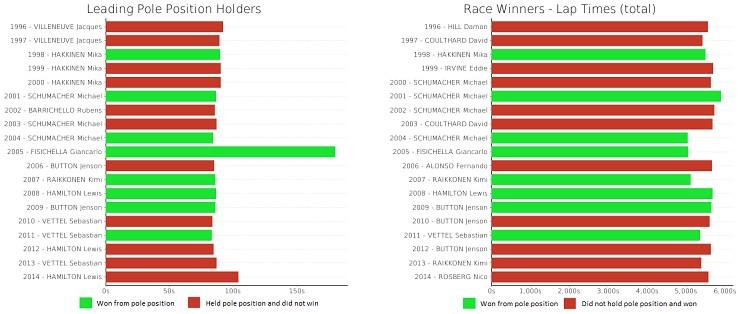 A closer look at race winners by year, qualifying time and total race time fails to reveal a definite correlation or trend-over-time regarding:
-
- Claiming pole and winning the actual race
-
- Pole position and total race time
-
- Lap 1: The all important launch-off-the-line and manic race into the first corner usually provides the most opportunity for overtaking, with Albert Park seemingly no exception
-
- Laps 15-23: Pit stop and tyre changes
-
- Laps 31-36: Final pit stop and tyre changes
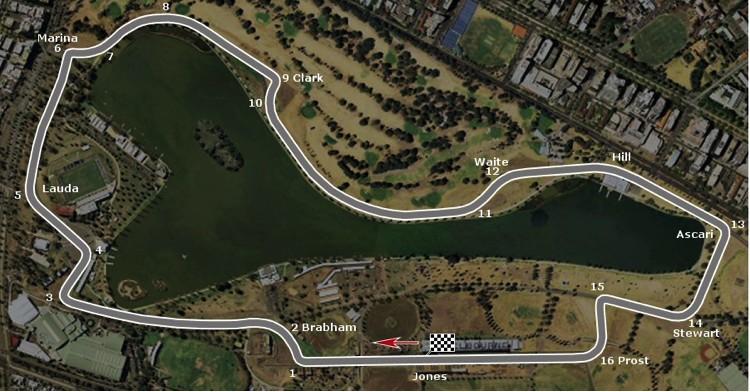 Since Australia’s F1 race moved from Adelaide to Melbourne in 1996, eight different car manufacturers and three different engine types have competed at Albert Park.
Ferrari and McLaren have been the most successful teams at the Australian Grand Prix in the last 19 years, winning a total of six titles each. Competitors powered by Mercedes engines have claimed eight victories in Melbourne, Ferrari six, and Renault five.
Who’s taking the chequered flag this Sunday?
So how will hometown hero, Ricciardo, perform in his Renault fuelled Red Bull? Will he be able to overcome the dominance of constructors Ferrari and McLaren, the power of Mercedes, and become the first Australian to win at home? It seems unlikely. The odds are stacked against him.
And, with offseason conjecture about his racing future, combined with the teaming-up of McLaren and Honda, it’s doubtful Button will be able to replicate his manful 2014 drive – despite his repeated recent success at Melbourne.
We reckon 2014 tough luck story, Lewis Hamilton, will narrowly outlast Mercedes teammate Nico Rosberg.
So who do you think will take the chequered flag this Sunday? Let us know on Twitter: @YellowfinBI
Since Australia’s F1 race moved from Adelaide to Melbourne in 1996, eight different car manufacturers and three different engine types have competed at Albert Park.
Ferrari and McLaren have been the most successful teams at the Australian Grand Prix in the last 19 years, winning a total of six titles each. Competitors powered by Mercedes engines have claimed eight victories in Melbourne, Ferrari six, and Renault five.
Who’s taking the chequered flag this Sunday?
So how will hometown hero, Ricciardo, perform in his Renault fuelled Red Bull? Will he be able to overcome the dominance of constructors Ferrari and McLaren, the power of Mercedes, and become the first Australian to win at home? It seems unlikely. The odds are stacked against him.
And, with offseason conjecture about his racing future, combined with the teaming-up of McLaren and Honda, it’s doubtful Button will be able to replicate his manful 2014 drive – despite his repeated recent success at Melbourne.
We reckon 2014 tough luck story, Lewis Hamilton, will narrowly outlast Mercedes teammate Nico Rosberg.
So who do you think will take the chequered flag this Sunday? Let us know on Twitter: @YellowfinBI