

Proving ROI on On-Premises BI: Quantify Data Security Value for CFOs and CIOs
Most teams can explain why sensitive BI data should stay on-premises. Far fewer can explain what that decision is worth in dollars.
That gap matters. IT can see the control benefits. Finance wants numbers. Executives want a simple answer: what risk drops, what costs change, and what value shows up over 3 to 5 years?
This is where a business case beats a technical pitch. On-premises BI can protect sensitive data, support compliance, and give teams direct control over hosting. But those benefits need translation into ROI, cost avoidance, and strategic value.
That is the real job for Yellowfin users and analytics leaders. They need to defend architecture choices to CFOs, CIOs, CISOs, and board members. They need a clear model, not a vague claim.
The good news is that the model is not hard to build. You can tie security to breach costs, audit effort, downtime, and decision speed. Once those numbers sit in one place, the case gets much easier to make.
Why the On-Premises Security Conversation Is Changing Now
Cyber risk is no longer an IT-only issue. Ransomware, insider misuse, and data theft now reach the balance sheet. That pushes sensitive analytics data higher on the executive agenda.
The cost side is well known. IBM's Cost of a Data Breach Report keeps showing that breaches bring direct response costs, lost business, and long cleanup cycles. For BI teams, that matters because analytics platforms often sit close to revenue, customer, HR, and finance data.
Executives also face more pressure to show risk governance in plain terms. That means fewer hand-wavy controls and more measurable outcomes.
Regulatory pressure and disclosure requirements
Rules raise the stakes again. GDPR, HIPAA, PCI DSS, and sector rules all shape how data can move, where it sits, and who can touch it. The EU GDPR portal explains the reach of personal data rules. HHS HIPAA guidance covers protected health information. The PCI Security Standards Council sets controls for payment data.
That is not just a legal checklist. It affects continuity, audit cycles, and board reporting. If analytics data sits in the wrong place, the cost is not only a fine. It is delay, review work, and added exposure.
What Stakeholders Actually Want to Know About On-Prem BI
CFOs usually ask three things first.
What will this cost over 3 to 5 years? What risk drops if we keep BI on-premises? What is the financial gap versus cloud?
That question set is fair. A CFO does not need a server diagram. They need a risk-adjusted view of spend, loss avoidance, and operating stability. They also want to know whether a cloud model looks cheaper only because the hard costs show up later, in transfer fees, egress, or governance labor.
If you cannot answer with numbers, the case stalls.
CIO, CISO, and business leader questions
CIOs want fit. Does this work with current systems, identity tools, data pipelines, and support teams?
CISOs want control. Can we limit exposure, keep access tight, and prove governance?
Business leaders want value. Will trusted data move faster? Will teams make better decisions? Will the company get more useful analytics without handing over hosting control?
Yellowfin's on-premises model fits teams that want analytics capability without giving up infrastructure control. That matters in regulated sectors, large-data settings, and firms with strict internal policy.
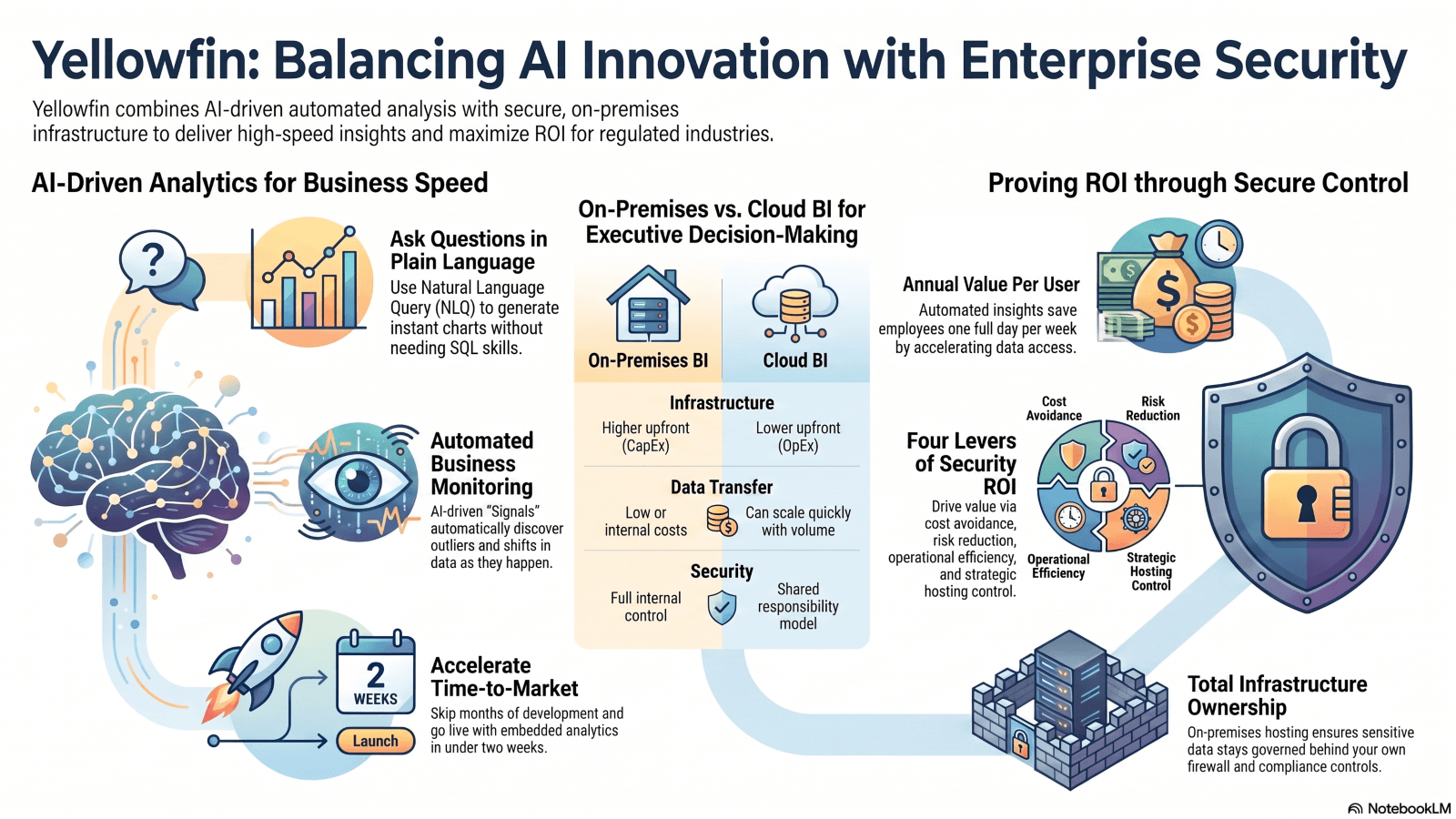
The ROI Framework for On-Premises Data Security in BI
Security ROI is rarely one line in a budget sheet. It is a mix of avoided loss and better output.
Build the case around 4 value levers:
- Cost avoidance - breaches, downtime, penalties, remediation
- Risk reduction - lower chance or lower impact of incidents
- Operational efficiency - fewer delays in access and approval
- Strategic value - trust, speed to insight, and hosting control
That is the language executives use. It turns security from a fear story into a financial story.
Turn security outcomes into measurable metrics
A strong model uses simple metrics.
- Estimated annual loss expectancy, or ALE
- Breach response costs
- Compliance audit prep hours saved
- Analyst productivity gains
- Time to access sensitive data
- Downtime avoided
Pair those numbers with internal benchmarks and outside references. NIST cyber risk guidance gives a solid structure for that kind of model.
If one control lowers the chance of a major event by even a small amount, the value can be real.
Comparing On-Prem vs Cloud: Total Cost of Ownership Over 3 to 5 Years
What should you include in the TCO model? Do not stop at the license price. Add the full stack.
- Infrastructure or hosting costs
- Security tooling and maintenance
- Backup and disaster recovery
- Compliance overhead
- Data transfer and egress charges
- Internal labor for admin and governance
- Upgrade and support costs
That is where real ownership costs show up.
Present the decision in executive-ready terms
Cloud can look cheaper at purchase time. On-prem can look heavier at first. But large sensitive BI environments often shift the math. Data volume, transfer constraints, and compliance work can make cloud more expensive over time.
Yellowfin's on-prem rationale is simple. Direct control matters. Large data sets can be hard to move. Regulated industries often want local hosting choices.
Yellowfin is a software vendor, not a host of customer data. Customers manage the environment. That makes TCO ownership part of the buying decision, not an afterthought.
| Cost Category | On-Premises BI | Cloud BI | Executive Interpretation |
| Infrastructure / Hosting | Higher upfront | Lower upfront | CapEx vs OpEx tradeoff |
| Data Transfer / Egress | Low or internal | Can scale quickly | Important for large data volumes |
| Security Control | High | Shared responsibility | Stronger governance on-prem |
| Compliance Overhead | Predictable | Can vary by architecture | Depends on data sensitivity |
| Internal Admin Effort | Moderate to high | Lower to moderate | Balance with control needs |
Quantifying Risk Reduction in Financial Terms
Start with incident cost buckets.
- Direct remediation
- Legal and notification costs
- Customer churn
- Downtime
- Reputational damage
IBM's breach research helps frame those costs in a credible way. Even a modest drop in incident probability can justify spending if the downside is large enough.
A useful method is simple:
risk value = incident probability x financial loss
If on-premises hosting lowers exposure, improves access control, or keeps sensitive BI data out of broader shared systems, the math may favor local control.
Compliance penalty avoidance and audit efficiency
Compliance value is not only about avoiding fines. It also includes less audit prep, fewer review cycles, and less legal friction.
GDPR and HIPAA enforcement guidance show how serious mishandling can get. The bigger point is not a guessed penalty amount. It is the cost of delay, legal review, and internal disruption.
If auditors need less evidence gathering, teams save hours. If approvals move faster, projects start sooner. That is real value.
Stakeholder-Specific Value Propositions for On-Prem BI
For the CFO and board narrative, lead with this line: "This protects revenue, avoids loss, and reduces long-term operating volatility."
That lands well because it is simple. It frames security as asset protection and risk-adjusted return. It also keeps the focus on predictability.
For boards, on-prem BI is not just an IT choice. It is a balance sheet choice.
CIO, CISO, and business leader narrative
CIOs want architecture control and clean integration with enterprise systems.
CISOs want measurable posture, clear governance, and less exposure.
Business leaders want fast access to trusted analytics. They also want fewer workarounds and better decision confidence.
That is where Yellowfin's collaborative analytics story fits. Users get governed data, but they still move fast. Stories, dashboards, and alerts help teams act on the same version of the truth.
How to Build a Business Case Executives Will Approve
Use a 1-page executive summary with assumptions. Keep it short.
Include:
- Problem statement
- Proposed solution
- Cost model
- Risk model
- Expected payback period
- Recommendation
Put technical detail in an appendix. Make every assumption visible. Finance teams want to test the inputs, not guess them.
Add proof points from usage, productivity, and adoption
Security alone rarely closes the deal. Add usage data.
Show:
- Time saved per analyst or business user
- Adoption gains from self-service analytics
- Reduced delay in reporting or decision cycles
Yellowfin helps here with stories, dashboards, alerts, and AI-assisted insights. That kind of access turns secure data into daily use, not shelfware.
| Section | What to Include | Why It Matters |
| Business Problem | Sensitive data requires controlled hosting | Establish urgency |
| Risk Exposure | Breach, compliance, and downtime costs | Quantify downside |
| Financial Model | 3-5 year TCO and payback period | Support budgeting |
| Strategic Benefit | Trust, speed, control, competitive advantage | Appeal to leadership |
| Recommendation | On-prem, hybrid, or phased deployment | Drive decision |
Evidence and Examples That Strengthen the Argument
Reference industry examples and common success patterns. Financial services, healthcare, and public-sector teams often choose on-prem for one of three reasons: regulation, data gravity, or internal policy.
A common pattern looks like this. A firm keeps sensitive reporting local, limits access through role controls, and reduces the chance of uncontrolled data movement. Audit work drops. Response time improves. Users still get the analytics they need.
Productivity and trust as measurable business outcomes
When users trust the data, adoption rises. That is a business result, not a soft benefit.
Secure analytics can cut workarounds. It can also improve collaboration because teams stop arguing about which report is right.
Yellowfin's live data storytelling and embedded analytics fit that pattern well. The platform gives teams a way to share governed analytics without making them clumsy to use.
Why Yellowfin Fits This Conversation
The short answer is: secure analytics without losing business usability. Yellowfin already supports the controls teams expect. That includes RBAC, metadata-layer security, SSO, MFA, content permissions, and compliance posture.
That mix matters. It keeps sensitive analytics governed while still giving business users self-service tools. Yellowfin 9.17 adds more AI-driven interaction, which helps teams ask questions faster and work with live data more naturally. See the latest release notes.
On-prem hosting aligned with enterprise control requirements
Yellowfin does not host customer data. Customers manage the software environment.
That fits firms that need direct hosting control for sensitive or regulated data. It also fits teams that want analytics close to their internal systems and existing data estate.
Related resources worth reviewing:
Conclusion - Translate Security into Business Value, Then Make the Case
On-prem BI for sensitive data is easiest to approve when the story is financial, not just technical.
Quantify risk. Compare 3 to 5 year costs. Map benefits to each stakeholder. Then present the result in executive language.
That is the right path for CFO data security justification and for any BI security business case tied to sensitive data BI. If the numbers support it, on-premises BI ROI becomes clear.
If you are preparing a business case for secure on-prem BI, start with the risk and TCO model, then review how Yellowfin can support governed analytics without sacrificing usability.