

How Embedded Analytics Powers Frontline Decision-Making: The Yellowfin Advantage
Blog Contents
show
That's the promise of embedded analytics—and it's transforming how businesses empower their frontline workers to make smarter decisions in real time.
Are you ready to see how embedded analytics can transform your frontline operations? Explore Yellowfin's capabilities or request a demonstration with your own data to experience the difference firsthand.
The Frontline Decision-Making Gap
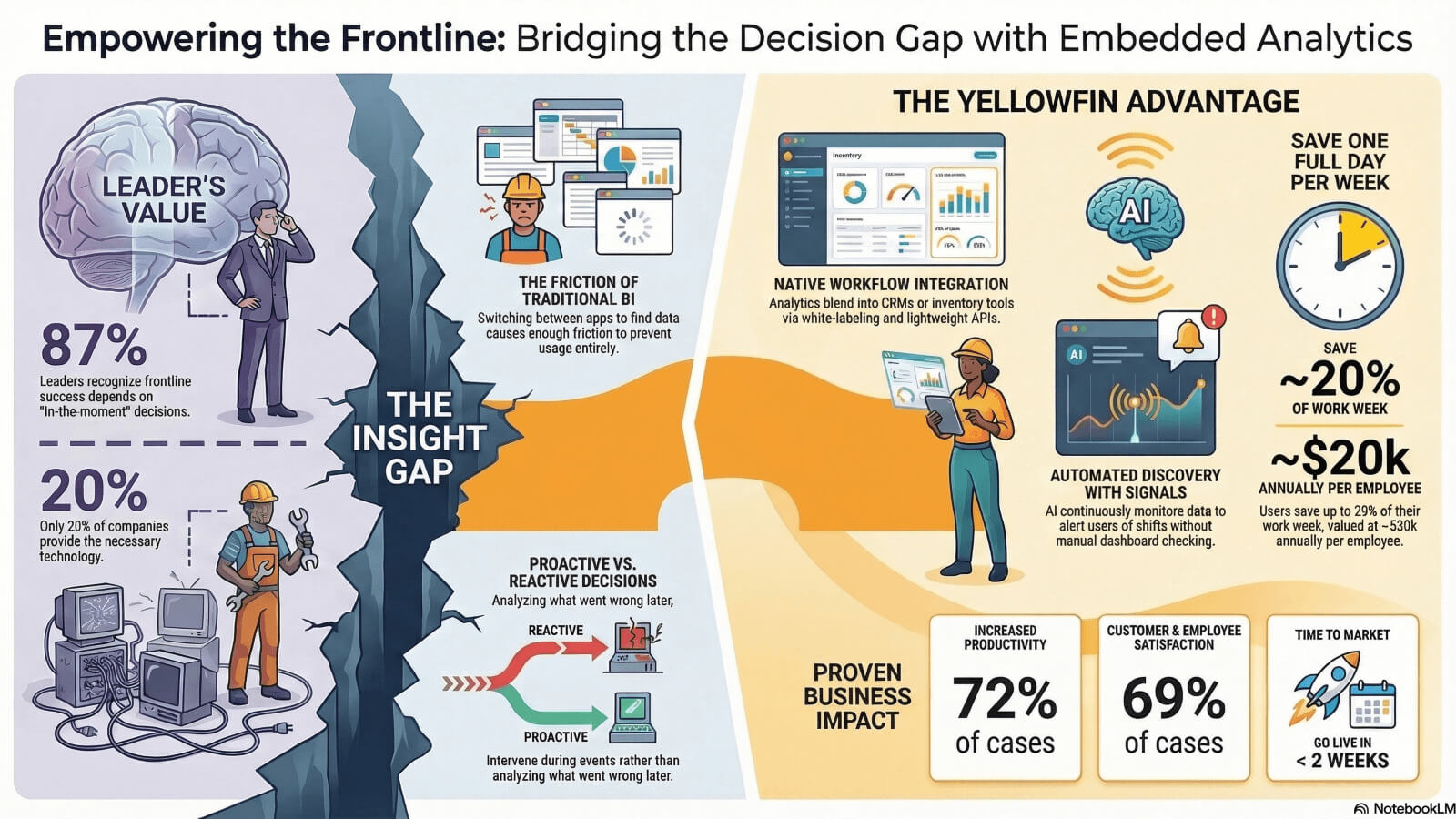
Here's a sobering statistic: research shows that 87% of business leaders believe their success depends on enabling frontline employees to make important decisions in the moment. Yet only one-fifth of companies say they've actually equipped their workforce with the technology to do so. The problem isn't a lack of data. Most companies are drowning in it. The real challenge is getting the right insights to the right people at the right time—right where they work. Frontline workers—whether they're retail merchandisers, healthcare providers, financial advisors, or manufacturing supervisors—sit at the intersection of your business and your customers. They're the ones who spot trends first, encounter problems in real time, and have the opportunity to act while it still matters. But too often, they're making critical calls based on gut instinct rather than data, simply because accessing that data is too complicated, too slow, or requires logging into yet another system. This is where embedded analytics changes everything.What Makes Embedded Analytics Different?
Traditional business intelligence tools are powerful, but they have a fundamental flaw: they live outside your workflow. You have to stop what you're doing, open a separate platform, run a report, and then try to apply those insights back to your original task. For busy frontline teams, that friction is often enough to prevent them from using analytics at all. Embedded analytics takes a different approach. Instead of forcing users to come to the data, it brings the data to them—directly within the applications they use every day. Whether that's a CRM system, an inventory management platform, a patient care application, or a custom business tool, the analytics seamlessly blend into the user experience. Think of it like the difference between checking the weather on a separate website versus having the temperature displayed right on your phone's home screen. Both give you the information, but one requires almost no effort to access and actually gets used. The benefits go far beyond convenience. When analytics are truly embedded, they become contextual. A sales manager viewing a customer account doesn't just see revenue numbers—they see trend analysis, purchase patterns, and predictive insights specific to that customer, right in context. A warehouse supervisor tracking inventory can immediately see demand forecasts, supplier performance metrics, and optimal reorder points without switching applications.
Real-Time Insights Are Where Decisions Happen
Speed matters in business, especially at the frontline. By the time a traditional report makes it through the pipeline—data extraction, analysis, formatting, distribution—the opportunity may have already passed. Real-time embedded analytics deliver insights as events unfold. When a manufacturing line starts showing quality deviations, the supervisor knows immediately. When the risk of customer churn spikes in a particular segment, the retention team can act before those customers walk away. When inventory levels hit reorder thresholds, purchasing managers receive alerts without having to check dashboards manually. This immediacy transforms decision-making from reactive to proactive. Instead of analyzing what went wrong last quarter, frontline teams can intervene while they still have time to change the outcome. Consider the retail sector, where margins are tight and competition is fierce. A store manager equipped with embedded analytics can monitor shopper trends, track conversion rates, and identify inventory issues in real time. When a particular product starts flying off the shelves unexpectedly, they can adjust displays, call for restocks, or capitalize on the trend with targeted promotions—all while the buying momentum is still active. In healthcare, the stakes are even higher. Doctors and nurses using electronic medical records with embedded analytics can receive instant risk alerts based on patient vitals, medical history, and treatment protocols. Instead of manually correlating data from multiple sources, they get AI-driven recommendations for diagnosis and treatment at the point of care, potentially saving lives through faster, more informed decisions.How Does Yellowfin Make Embedded Analytics Work?
Yellowfin BI has built its platform specifically for embedded analytics use cases, with features designed to support frontline decision-making at every level.Seamless Integration, Zero Friction
Yellowfin embeds directly into applications using a lightweight JavaScript API or secure iframes, making implementation straightforward for development teams. But here's what makes it special: the analytics don't just sit inside your app—they feel like a native part of it. Through its comprehensive white-labeling capabilities, Yellowfin allows every visual element to be customized so the analytics match your application's look and feel. Users don't see "Yellowfin-powered analytics"—they simply see their application providing smart, data-driven insights. This seamless integration drives adoption because there's no learning curve, no separate login, and no cognitive friction.Automated Discovery with Yellowfin Signals
One of Yellowfin's standout features is Signals, an automated analysis engine that continuously monitors data and intelligently alerts users to significant changes as they happen. Instead of requiring frontline workers to build dashboards for every possible scenario or manually check reports hoping to spot important trends, Signals does the heavy lifting. It automatically detects outliers, trend changes, step shifts, volatility changes, and other statistically significant patterns across your data—often examining far more combinations than any human could reasonably track. When Signals finds something important, it doesn't just send a generic alert. It provides natural language explanations of what changed, performs automated root cause analysis to identify correlated factors, and ranks notifications based on relevance to each individual user. This personalization means frontline workers aren't overwhelmed with noise—they only see the insights that matter to their role and responsibilities. For a fintech company, Signals might automatically detect unusual drops in payment processing across specific geographies or devices, allowing support teams to investigate and resolve issues before they impact more customers. For manufacturers, it could identify emerging process issues affecting product quality, enabling quick intervention before defects multiply. For retailers, it tracks conversion rates, revenue changes, and potential fraud patterns—all without manual setup or constant monitoring.Self-Service Analytics Through Natural Language
Not every frontline worker is a data analyst, nor should they need to be. Yellowfin's Guided Natural Language Query allows users to simply ask questions in plain English and receive instant, visual answers. "What happened to revenue last quarter?" "Which products are driving the most growth this month?" "Show me customer satisfaction by region." These natural language queries eliminate the need for SQL knowledge, complex filters, or training on report-building tools. The system remembers context, so follow-up questions build on previous queries, making exploration feel effortless. This self-service capability is transformative for frontline decision-making. When a regional manager notices an unusual pattern, they can investigate immediately rather than submitting a request to the analytics team and waiting days for a response. When a customer success manager needs to understand account health before a renewal call, they can get those insights in seconds, not hours.Contextual Analytics That Fit Your Workflow
Yellowfin's approach to contextual analytics means insights appear exactly when and where they're needed. If you're working with customer data, you see customer-specific analytics. If you're reviewing inventory, you see supply chain insights. The analytics adapt to your current task, providing relevant information without requiring you to specify what you need. This contextual delivery is powered by Yellowfin's understanding of user roles, data permissions, and workflow patterns. A sales executive sees different metrics to a sales representative, even when viewing the same customer account. A regional operations manager sees aggregated location data, while individual store managers see details specific to their location. The right insights reach the right people automatically.Data Storytelling for Clearer Communication
Raw numbers and charts tell only part of the story. Yellowfin Stories combines visualizations with narrative context, helping frontline workers not just see what happened, but understand why it matters and what actions to consider. For customer-facing teams that need to report back to clients on product usage or performance, Stories automates this process, delivering professional, narrative-driven reports that combine charts, tables, and explanatory text. This capability saves time and ensures consistent, high-quality communication across the organization. Stories also support collaboration, allowing teams to discuss insights, share findings, and build collective understanding around data. When a Signal reveals an important trend, team members can add it to a Story, annotate it with context, and share it with stakeholders—turning individual insights into organizational knowledge.The Business Impact of Empowered Frontline Teams
When frontline workers have access to embedded analytics, the benefits cascade throughout the organization. Faster, Better Decisions: With real-time insights at their fingertips, frontline teams can respond to opportunities and threats immediately rather than waiting for scheduled reports or approval from headquarters. This agility translates directly to competitive advantage. Increased Productivity: Eliminating the need to switch between applications, request reports from IT, or manually compile data frees up significant time. Workers spend less time hunting for information and more time acting on it. Improved Customer Experiences: When customer-facing teams have instant access to account history, behavior patterns, and predictive insights, they can personalize interactions, anticipate needs, and resolve issues more effectively. Customers notice the difference. Better Resource Allocation: Operations managers with embedded analytics can optimize inventory levels, adjust staffing based on demand patterns, and identify efficiency opportunities—all leading to reduced costs and improved performance. Data-Driven Culture: When analytics are accessible and easy to use, they become part of everyone's daily workflow rather than the domain of specialized analysts. This democratization of data encourages a culture where decisions at every level are grounded in evidence rather than intuition. Research supports these benefits. Companies that successfully empower frontline workers with analytics tools report productivity increases of at least moderate levels in 72% of cases, along with improvements in both customer and employee satisfaction in 69% of cases, according to studies on frontline decision-making.The Technology That Makes It Possible
Behind the user-friendly interface, Yellowfin's technical architecture is designed for reliability and scale. The platform handles multi-tenant deployments securely, supports single sign-on for seamless authentication, and provides granular control over data access at the user, role, group, and content level. For development teams, Yellowfin offers flexibility through multiple integration options—from simple iframe embedding to extensive API-based customization. The open platform architecture doesn't lock you into proprietary databases or development languages, allowing you to leverage existing skills and infrastructure. The platform scales to accommodate growing data volumes and user bases without performance degradation, making it suitable for both emerging startups and global enterprises. Whether you're embedding analytics into a SaaS product with thousands of customers or deploying it across a multinational workforce, Yellowfin's architecture can handle the load.Choosing the Right Embedded Analytics Partner
Not all embedded analytics platforms are created equal. When evaluating options for supporting frontline decision-making, several factors matter: Ease of Integration: How quickly can your development team embed the analytics? Does the platform offer white-labeling so it feels like part of your product rather than a bolted-on tool? User Experience: Will your frontline workers actually use it? Is it intuitive enough for non-technical users? Does it work on mobile devices for field teams? Automation Capabilities: Does the platform proactively surface insights, or does it require users to know what to look for? Can it handle the scale of monitoring that frontline operations require? Customization and Control: Can you tailor the analytics to your specific workflows and use cases? Do you have control over branding, security, and data access? Scalability and Performance: Will the platform handle your growth? Can it deliver real-time insights even as data volumes increase? Yellowfin scores strongly across all these dimensions, which is why hundreds of enterprise software developers and thousands of companies trust it for their embedded analytics needs. The platform's focus on usability, automation, and seamless integration makes it particularly well-suited for frontline decision-making scenarios where simplicity and speed are paramount.Getting Started with Embedded Analytics
Implementing embedded analytics doesn't have to be a massive undertaking. The key is starting with clear use cases that will deliver immediate value to your frontline teams. Identify where your frontline workers are currently struggling with access to information. Is it sales reps who need customer insights during calls? Operations managers who need real-time production metrics? Customer service teams who need account history at their fingertips? Start with one high-value use case, implement embedded analytics to address it, measure the impact, and then expand from there. Yellowfin offers proof-of-concept programs that allow you to see the platform in action with your own data and workflows before committing to a full implementation. The technical implementation typically takes weeks rather than months, especially compared to building analytics capabilities in-house. Yellowfin's team provides guidance throughout the process, from initial planning through deployment and beyond.The Future of Frontline Decision-Making
As artificial intelligence and machine learning capabilities continue to advance, embedded analytics will become even more powerful. We're moving toward a future where analytics don't just show what happened—they predict what will happen and recommend specific actions. Imagine a warehouse manager whose system not only alerts them to low inventory but automatically suggests optimal reorder quantities based on demand forecasts, supplier lead times, and budget constraints. Or a healthcare provider whose system doesn't just flag patient risk but recommends specific interventions based on clinical evidence and patient characteristics. Yellowfin is already incorporating these capabilities through its automated analysis, natural language processing, and intelligent alerting features. As the platform evolves, frontline workers will have access to increasingly sophisticated decision support—all delivered through the same simple, embedded interface they're already using.The Bottom Line
The gap between having data and making data-driven decisions is wider than many companies realize. Closing that gap—especially for frontline workers who need insights most—requires more than just access to information. It requires analytics that are embedded, contextual, automated, and genuinely easy to use. Yellowfin delivers on all these requirements with a platform specifically designed for embedded analytics use cases. Through seamless integration, automated discovery with Signals, natural language querying, and intelligent personalization, Yellowfin empowers frontline teams to make faster, smarter decisions without leaving their workflow. In a business environment where speed and agility determine competitive success, can you afford to keep your frontline teams waiting for insights? Or is it time to bring analytics directly to the point of decision—where they'll actually get used and drive results? The technology exists. The benefits are proven. The question is simply when you'll make the move.Are you ready to see how embedded analytics can transform your frontline operations? Explore Yellowfin's capabilities or request a demonstration with your own data to experience the difference firsthand.