
On-Prem and Private Cloud Deployment Models for Analytics

Why Deployment Model Decisions Are Now an Analytics Strategy Issue
Leadership keeps asking for more dashboards, faster answers, and tighter compliance. The data team hears a different message: do more with the same staff (or, fewer). That is where the difficulty evaluating on-prem and private cloud deployment models for corporate data analytics and visualization solutions starts to bite.
The wrong choice adds ticket volume, slows releases, and forces teams to babysit infrastructure. The better choice is not the one with the slickest network diagram. It is the one that keeps analytics moving without piling on operational work.
What will this article clarify?
This article explains what on-prem and private cloud deployment models mean for analytics teams. It also compares hidden costs, scale limits, security trade-offs, and migration pain. It then shows how YellowfinBI fits as an embedded analytics option that works inside current environments instead of forcing a full rebuild.
Understanding On-Prem and Private Cloud Deployment Models in Analytics
On-prem deployment model: control, isolation, and operational burden
On-prem means the analytics stack runs on hardware and systems the company owns and runs itself. For BI and visualization tools, that usually means tighter control over data locality, access rules, and internal governance. It can fit firms with strict policies or limited tolerance for outside infrastructure.
The trade-off is simple. Procurement takes time. Capacity is fixed. Upgrades, patching, backups, and tuning stay on the internal team. On-prem starts can stretch far longer than leaders expect, which creates risk before value appears.
Private cloud deployment model: flexibility with cost and governance trade-offs
Private cloud uses dedicated cloud infrastructure for one company. That helps regulated teams and larger enterprises. It also comes with a price tag. Dedicated infrastructure costs more. Setup can need specialist skills. Vendor dependence can rise, especially when the stack is built around one provider.
The Hidden Costs and Evaluation Pitfalls Leaders Commonly Miss
TCO is bigger than infrastructure
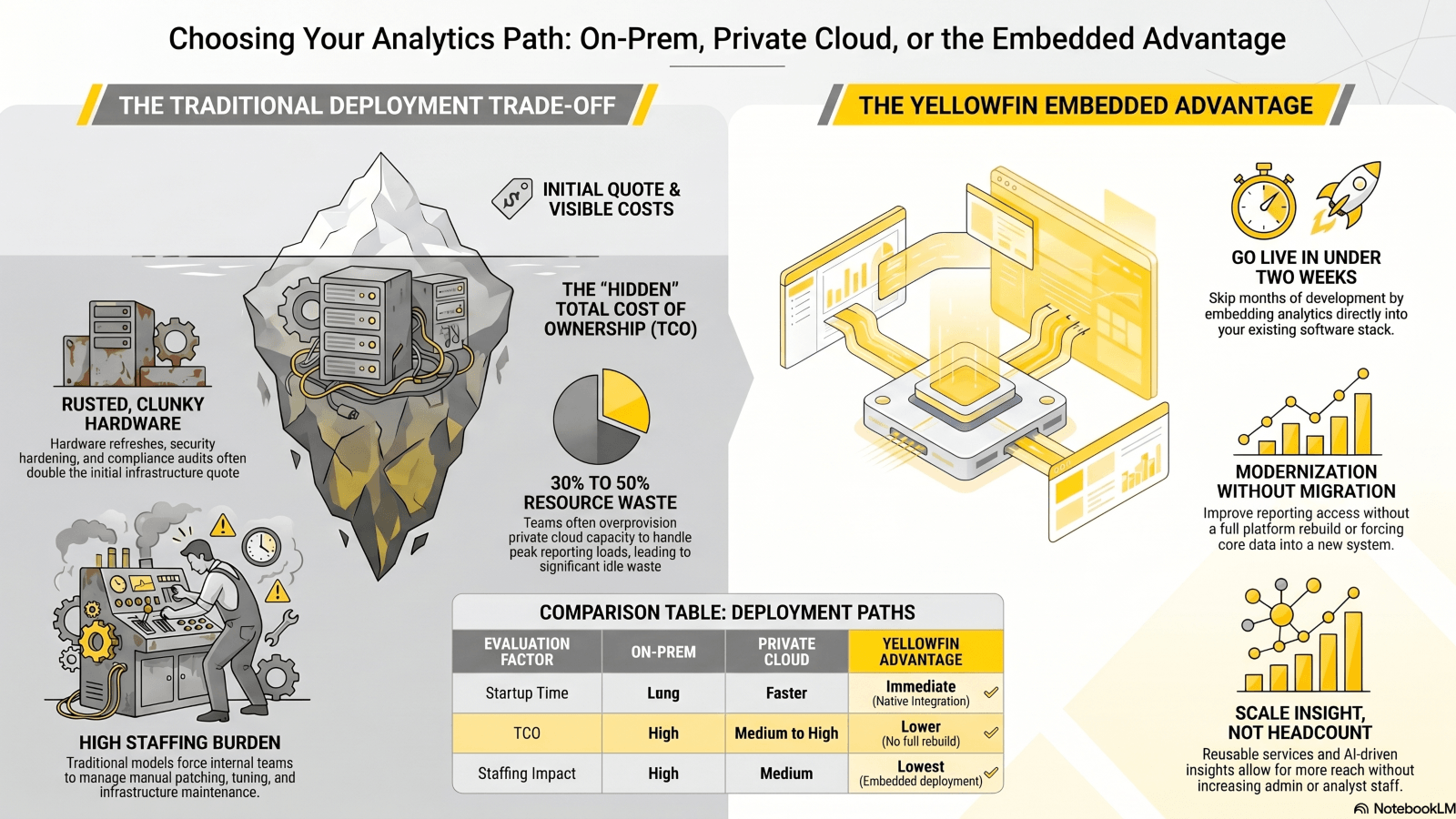
Total cost of ownership is where many evaluations go wrong. A platform may look cheaper on paper, then grow expensive once real work begins. Hardware refresh cycles, security hardening, compliance audits, integration work, and internal support all sit outside the first quote.
That gap matters. Hybrid and private models often hide ongoing service costs behind lower headline numbers. The least expensive model at purchase can turn into the most expensive model to run.
Why evaluation gets derailed before value is proven
Many buyers review architecture diagrams long before they test operational load. That leads to the same mistakes again and again. Timelines get underestimated. Internal capacity gets overstated. Query growth gets ignored. Maintenance and tuning get treated like minor tasks.
For analytics teams, that creates a trap. The deployment model gets approved, but the reporting backlog keeps growing.
YellowfinBI reduces that friction because it works inside current environments. Embedded analytics cuts the need for a full platform migration and lets teams ship reporting value sooner.
| Evaluation Factor | On-Prem | Private Cloud | YellowfinBI Advantage |
| Startup time | Long | Faster | Works inside current environment |
| Hidden costs | High | Medium to high | Lower due to no full rebuild |
| Staffing burden | High | Medium | Lower through embedded deployment |
| Flexibility | Low to medium | High | High without architecture overhaul |
Scalability, Performance, and Resource Waste: Where Traditional Models Break Down
On-prem scaling ceilings and private cloud overprovisioning
On-prem analytics often hits a hard ceiling during spikes in reporting, forecasting, or dashboard use. More users mean more load. More load means more hardware. That path gets expensive fast.
Private cloud looks better on scale. It can add capacity faster, at least in theory. But many teams overprovision so the platform feels fast under peak load. Elasticity does not always equal efficiency. In practice, 30 to 50 percent idle capacity is common when teams buy for worst-case demand.
How YellowfinBI helps teams scale analytics without hiring more people
YellowfinBI, through yellowfinbi.com, is built around embedded analytics. That matters because it lets companies scale dashboards, reports, and self-service BI inside the systems they already run.
The value is practical:
- efficient querying that avoids waste
- embedded visualization inside business apps
- reusable analytics services
- better handling of variable demand
The point is not to replace the deployment model. The point is to make the model produce more value per admin, per analyst, and per server.
Security, Sovereignty, and Compliance Trade-Offs for Regulated Data
Security is not just about isolation
On-prem is often seen as the safer option because the company owns the walls. That view is incomplete. Internal systems still fail when patching slips, access rules drift, or hardware goes stale. Private cloud can improve manageability, but it also adds provider dependency and shared underlying risk, even when the tenant boundary is strong. Security is a mix of isolation, controls, and operating discipline. The model matters. The run book matters more.
Why compliance-ready embedded analytics is a strategic advantage
Finance, healthcare, public sector, and insurance teams face tight rules around access, retention, and auditability. GDPR and HIPAA style demands make dashboard design part of the compliance stack, not a side task.
This is where YellowfinBI helps. It embeds analytics layers into on-prem and private cloud environments without pushing core data into a new platform. That preserves control, simplifies governance, and keeps reports close to regulated systems. Private cloud often earns its place in compliance-heavy settings, but the analytics layer still needs to be managed with care.
Migration and Hybrid Complexity: Why “Just Move It Later” Often Fails
Legacy analytics stacks rarely map cleanly to new environments
Migration plans often look neat in workshops. Reality is messier. Schemas do not line up. Integration points multiply. Hybrid systems create latency gaps. The old stack rarely maps one-to-one into the new one. The scope grows. So does the risk. In analytics, that means business users wait while technical teams rebuild plumbing.
Embedded analytics as a lower-risk modernization path
YellowfinBI gives teams a different path. API-based embedding allows phased adoption. Teams can keep current data stores, keep current deployment choices, and improve reporting access without starting over.
For executives, that matters. It avoids a large hiring cycle. It also avoids a forced replacement project just to get better dashboards.
Industry Perspective and Positioning: The Right Solution for Data-Driven Leaders
Preserve control, reduce complexity, scale insight
The best enterprise view is simple. Keep control where regulation demands it. Keep complexity low where growth pressure is high. Use the deployment model that supports delivery, not the one that sounds best in a vendor meeting.
That view fits CEOs, CTOs, and CIOs who need analytics growth without staff growth. It also fits data leaders who want fewer platform debates and more usable output.
YellowfinBI, on-prem and private cloud
YellowfinBI helps companies embed analytics into existing on-prem or private cloud environments. That means less infrastructure churn, less rebuild work, and less pressure to add new people just to keep reporting alive. The result is more reach from the stack already in place.
How YellowfinBI’s Embedded Analytics Improves On-Prem and Private Cloud Solutions
| Factor | On-Prem | Private Cloud | YellowfinBI-Embedded Analytics |
| Startup speed | Slow | Medium | Fast inside current stack |
| TCO | High over time | Medium to high | Lower due to no full rebuild |
| Scalability | Fixed | Better, but costly | Better use of current capacity |
| Compliance | Strong control | Strong with provider controls | Strong in either model |
| Staffing impact | High | Medium | Lower |
| Modernization path | Hard | Moderate | Phased, lower risk |
Conclusion: The Smartest Analytics Deployment Choice Is the One That Scales Without Adding Complexity
On-prem and private cloud deployment models both have a place in enterprise analytics. On-prem gives control. Private cloud gives more flexibility. Both can still create cost pressure, scale limits, and staffing strain if the analytics layer is poorly built.
That is why embedded analytics matters. YellowfinBI, at yellowfinbi.com, fits into existing environments and helps companies get more from the infrastructure they already own. For teams stuck between compliance demands and headcount limits, that is a practical path forward. Review TCO, security, and scale together. Then test how much analytics value can come from the stack already in place.