
Is BI dead? No, but the game has changed. A lot.
AI is reshaping many industries and tools at breakneck speed. Business Intelligence is no exception, but things might not end up in a way you might expect. There’s still hope for BI and vendors that manage to embrace, rather than try to fight the AI tsunami.
You are an executive looking for answers. Before, in order to get them you had to reach out to your analysts, or external agencies, or try to make sense of broken dashboards set by people who have left the company years ago.
Now you can upload a dataset to Claude, ask a question, and watch it reason, iterate, visualize, and provide answers in seconds. It’s genuinely impressive, but does it mean traditional BI tools are doomed?
It’s a legit question. Many enterprise SaaS valuations have taken a huge hit over the last months, as investors observe how AI platforms absorb parts of or even entire existing software stacks. BI tools sit squarely in the crosshairs of this disruption wave, but will AI platforms like Claude be able to replace business intelligence tools?
If you ask the AI evangelists, BI is already dead, but does this mean that it won’t have a role to play in the modern enterprise? History offers us some useful clues on what we could expect in the years to come.
We’ve seen this movie before
Consider Excel. It is an extraordinarily powerful analytical tool that has been dominating enterprise work for decades. And in the hands of a power user, Excel is arguably still more capable than many purpose-built analytics products.
The problem was never in Excel’s power. It was in the fact that in a team of any size you have different people building different spreadsheets stored in different locations, and that’s not how you can build a governed and scalable enterprise analytics system. Hence, modern BI tools were born, yet Excel still remained the weapon of choice of many analysts and executives.
Then came Tableau. It made Excel look static. The drill-downs, the visual fluency, the reduced time to insights… executives loved it. Tableau didn’t just improve on old BI; it redefined what analytics felt like. And yet, once again, it didn’t replace the need for centralized governance and enterprise-level data and reporting discipline. Managing hundreds of independent Tableau instances became a different kind of operational nightmare.
And now we have AI tools like Claude used in the context of business intelligence seem like a bigger leap than either of these. The ability to have a genuine analytical dialogue is qualitatively different from anything that came before. Many of my peers have developed a genuine working relationship with the tool, as it speaks their language and helps them get to insights and conclusions faster and easier.
There are problems AI platforms simply can’t solve
Here’s the problem: Claude is exceptional at exploratory analysis. But that’s about it. You export a portion of your data, it finds a trend or an outlier, so you send a couple of (AI generated) emails and move onto the next mundane task you haven’t automated yet, like people management or travel expenses.
Once you try to use any of the available AI tools in a way that fits the requirements of a serious business, which includes full compliance, scalability, and actual guardrails, they fall short quite quickly.
Enterprises don’t just need answers. They need answers that are consistent across time, various datasets and teams, traceable to certified data sources, and protected from unauthorized use and interpretation. Without any of this, none of the current BI tools could be used in any company larger than your local grocery store.
If we add MCP servers to the equation, things seem to move into a different direction. But to be able to benefit from the combination of Claude and MCP, you need an underlying semantic layer, a tool that will provide a reliable source of governed data that will feed the AI machine. And who’s gonna provide that?
You guessed it - this is the new role that BI tools need to take in order to become an integral part of the future corporate analytics stack. If BI tools evolve in the right direction, their place in the ecosystem won’t be diminished — they will actually become more important.
Especially in the embedded analytics use case, where a software company wants to integrate analytics into their product seamlessly, quickly, and with the controls that protect their data and domain expertise. Or when the regulatory framework is so strict that there are no viable alternatives to on-premise BI implementations that provide full control over handling sensitive data.
The foundations will remain within BI
General-purpose analytics — the kind a data analyst does in an exploratory session — is exactly where AI platforms will continue to move the needle. That market is genuinely at risk, as various AI tools and their ease-of-use make any legacy BI tool look cumbersome and obsolete.
Building your own analytics solution, especially with the plethora of new AI coding tools, is seductive and looks exciting, until you hit the governance layer. Getting semantic consistency, access controls, and certified metrics right is a multi-year infrastructure problem, not something a vibe-coder can solve in a weekend build on top of an LLM API.
The companies that have tried to build their own analytics solution quickly discovered they’ve traded a software vendor dependency for an engineering debt that needs an army of expensive specialists to turn the newborn solution into a tool they can rely on for the most important business decisions.
On top of that complexity sit the embedded BI tools, built for specific use cases and the most demanding customers. A software company embedding analytics into their product is not looking for a general-purpose intelligence AI can provide in a 100-word prompt. They need their data, their metrics, their visual language, and their access controls, all packaged in a way that their customers experience as part of the product, not a bolt-on.
AI platforms, by design, are generalists, while embedded BI is a specialist. The companies that will win in the BI arena are the ones that lean hard into this distinction: tighter governance, better visualization foundations, and a context layer that lets AI platforms like Claude do what they do best, without giving away the store.
The architecture that makes BI sustainable
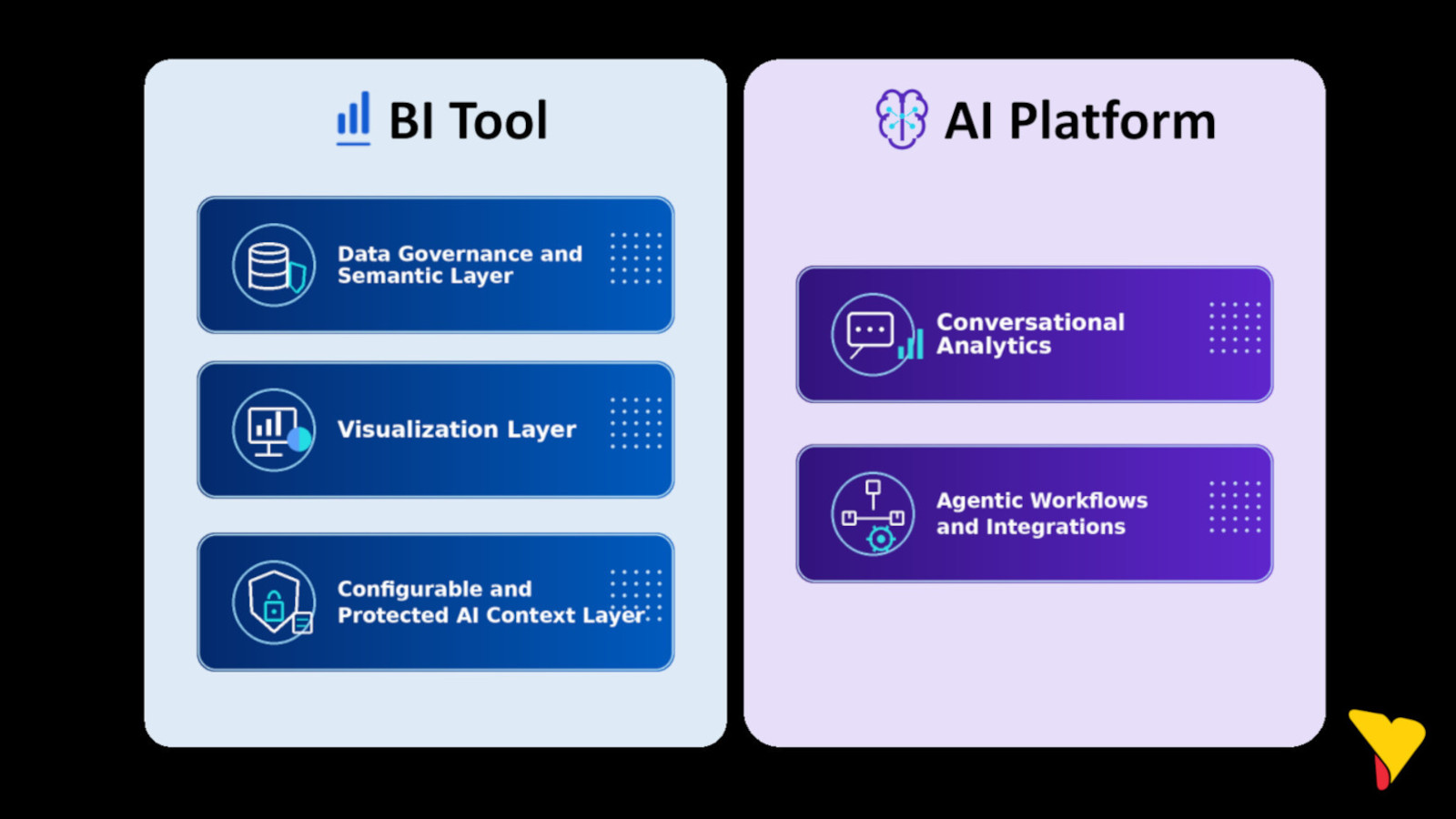
With that in mind, we can foresee a clean, three-layer architecture for BI tools of the future — one that integrates naturally with AI platforms rather than competing with them:
Layer 1: Data governance and semantic layer
Certified metrics, access controls, and business logic that doesn’t get reinvented per query, creating a source of truth that AI platforms can reference, not replace.
Layer 2: Visualization layer
High-quality, interactive rendering, purpose-built for embedded use and flexible enough to fulfill the user’s needs and wishes coming through a chat interface.
Layer 3: Configurable AI context layer
A protected interface between the BI stack and AI platforms, which controls what context, metrics, and domain knowledge gets exposed, and how.
In such an environment, governance and visualization will stay in the BI domain, while conversational and agentic capabilities plug into AI platforms. The context layer will act as the bridge, and this is where the vendor’s IP and expertise in creating this synergy with AI will become the key differentiator in a saturated market.
The bottom line - the path from Excel through Tableau to Claude was not a revolution that ate its own children. It was an evolution in which the incumbents learned to co-exist with the challengers. And this is why the analytics ecosystem doesn’t need less infrastructure - it needs better infrastructure, tightly integrated with AI platforms that can finally make it conversational.
The future of BI isn’t about resisting AI. It’s about building a stable, governed foundation that turns AI into a reliable partner, not an omnipotent enemy. The BI software vendors that have understood this won’t just survive the current wave of disruption — they’ll become more valuable because of it.
So, is BI dead? Not even remotely. But the idea that it will remain in its current position is definitely a thing of the past.