

The Data Hiring Dilemma: Scaling Analytics Without Expanding Headcount
To maintain a competitive edge, organizations must decouple their analytical capabilities from their headcount. This article explores a strategic pivot towards scaling analytics without increasing headcount, primarily through the adoption of Yellowfin’s embedded analytics. We will examine why the traditional "human-first" scaling model is faltering and how automated signals, assisted insights, and deep integration can empower your existing team to achieve peak productivity.
The Hidden Costs of a "Headcount First" Approach
The initial impulse when scaling an analytics solution is often to increase the number of personnel. This overlooks the substantial hidden costs and current market realities.
The Talent Shortage and Delayed ROI
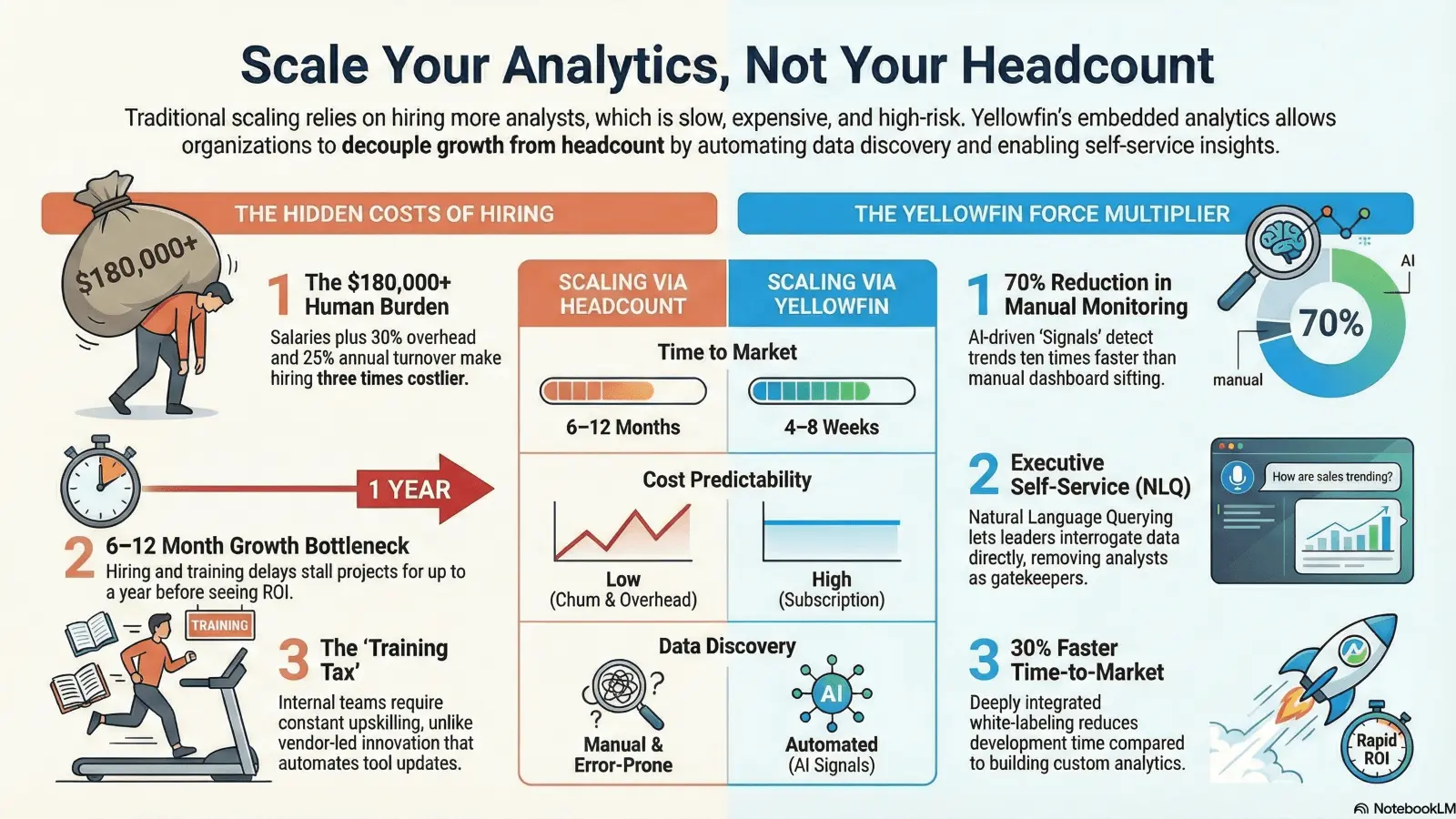
The global scarcity of talent has transformed analytics hiring into a challenging endeavor. With hiring delays averaging six to nine months, a project initiated today may not have its first dedicated team member onboard until the following year. This prolonged period of stalled growth places immense pressure on the existing team, leading to burnout. Furthermore, internal hires necessitate continuous upskilling on evolving technologies, a hidden "training tax" that solutions like Yellowfin, through continuous vendor-led innovation, effectively eliminate.
The $180,000 Burden and Employee Turnover
The salary of an analyst is merely the surface cost. Factoring in approximately 30% in overhead and accounting for high turnover rates, currently around 25% annually in data roles, the expense of scaling through headcount can be up to three times the cost of the software itself. By transitioning from a fixed headcount model to a predictable, subscription-based embedded BI approach, CTOs can convert variable, high-risk labor expenses into scalable, high-margin operational costs.
Harnessing Yellowfin to Automate Analyst Workflows
To scale analytics efficiently without adding personnel, it’s crucial to automate the most time-intensive phase of the data lifecycle: discovery. Yellowfin is engineered to serve as a force multiplier for your current workforce.
Yellowfin Signals: Accelerating Discovery Tenfold
Traditional scaling models require analysts to manually sift through dashboards to identify anomalies. Yellowfin Signals revolutionizes this process. Utilizing AI-driven automated monitoring, Signals detects trends and anomalies ten times faster than manual methods. This capability can reduce the analyst hours dedicated to data monitoring by as much as 70%, enabling your current team to manage substantially larger data environments without being overwhelmed.
Assisted Insights and NLQ for Executive Self-Service
A significant drain on data teams is the demand for ad-hoc queries from business decision-makers. Yellowfin’s Assisted Insights and Natural Language Query (NLQ) tools empower executives, such as CEOs and CFOs, to directly interrogate their data. This eliminates the analyst's role as a gatekeeper, effectively democratizing data science capabilities across the C-suite without the need for new hires.
Architecture for Lean Scaling: Integration and Governance
Effective scaling involves not only speed but also maintaining control. A common concern is that scaling without new hires might lead to "Shadow IT" and compromised data governance.
Deep Integration Versus Shallow Embeds
Many Business Intelligence (BI) tools offer "shallow" embedding through basic JavaScript APIs, which can introduce security vulnerabilities or demand constant developer oversight. Yellowfin, in contrast, provides deeply integrated, white-labeled solutions that seamlessly blend with your core product's user experience. This approach can reduce initial development time by as much as 20-30% and ensure your infrastructure remains robust as data volume increases.
Automated Governance at Scale
Yellowfin ensures governance through metadata-driven rules. Rather than hiring a dedicated Governance Officer to audit every query, the platform automatically audits 100% of queries. This guarantees that even as self-service analytics expand among non-technical users, compliance and data integrity are consistently maintained.
Comparison: Scaling Models
| Feature | Scaling via Headcount | Scaling via Yellowfin Embedded BI |
| Time to Market | 6–12 Months (Hiring + Ramping) | 4–8 Weeks (Integration) |
| Cost Predictability | Low (Salaries + Overhead + Churn) | High (Predictable Subscription) |
| Data Discovery | Manual (High risk of human error) | Automated (Yellowfin Signals) |
| Support Burden | Internal Team (40% of time spent) | Offloaded to Platform/Automation |
| Competitive Edge | Reactive (Dependent on hiring) | Proactive (AI-driven insights) |
Real-World Impact: Efficiency Through Case Studies
The efficacy of "scaling without headcount" is demonstrably proven by organizations that have adopted Yellowfin.
- Case IQ: Confronted with massive data expansion, Case IQ averted a hiring surge by embedding Yellowfin’s white-labeled dashboards. This strategy eliminated the need for additional analyst hires while simultaneously enhancing their user experience.
- SaaS Product Teams: By utilizing Yellowfin's comprehensive suite, including NLQ and AI alerts, one CTO reported achieving a market launch three months sooner and avoiding the associated costs of hiring three to five new developer/analyst positions.
Conclusion
In the current business landscape, headcount is a lagging indicator of success rather than a leading one. Scaling analytics through recruitment is a slow, costly, and increasingly challenging process, exacerbated by global talent shortages. By partnering with an embedded analytics provider like Yellowfin, organizations can automate data discovery, facilitate self-service insights for executives, and uphold stringent governance standards—all while maintaining a lean operational structure.
Ready to scale your analytics without the burden of extensive hiring?
Request a Yellowfin Demo today to discover how automated signals can revolutionize your data strategy.
FAQ: Scaling Analytics Without Headcount
- How does Yellowfin Signals reduce the need for more analysts?
Yellowfin Signals automates the discovery process. AI-powered alerts identify changes and anomalies, significantly reducing the manual effort analysts spend on dashboard monitoring—by up to 70%.
- Are these tools accessible to non-technical executives?
Yes. Through features like Assisted Insights and Natural Language Querying (NLQ), non-technical users can ask questions of the data using plain English, generating visualizations without requiring analysts to write complex SQL queries.
- Does embedded BI lead to vendor lock-in?
While reliance on a vendor for updates exists, this is often preferable to "hiring lock-in," where critical institutional knowledge resides with individual employees who may depart. Yellowfin offers flexible, deep API integration, ensuring you retain control over your user experience.
- What are the development time savings with white-labeling?
Utilizing pre-built, customizable components typically reduces initial development time by 20-30% compared to building a custom analytics solution from scratch.
- How does Yellowfin manage data governance during scaling?
Yellowfin employs a metadata layer to enforce security and access protocols. This ensures that as more users engage with the data, the platform automatically maintains compliance and a unified "single source of truth."