
From Data to Decisions: How AI-Powered Analytics Speeds Up Business Impact
TL;DR
Most organizations are swimming in data, but still struggle to turn it into clear decisions. AI-powered analytics bridges that gap by automating routine analysis, surfacing hidden insights, and making data accessible to everyone through natural language.
Instead of just looking at what happened, teams can understand why it happened and what to do next. The result is faster, smarter decision-making and a stronger competitive edge.
Provide your users with the latest AI-powered analytics features. Get a free trial of Yellowfin BI.
We all know the mantra: be data-driven.
But for many enterprise companies and ISVs Yellowfin speaks to, the reality is often more complex.
Despite having more data than ever before, there is a persistent gap between the data collected and the decisions we need to make. It isn’t for a lack of effort, however, but a systemic challenge.
Teams spend hours building dashboards, running reports, and trying to piece together context, plus the “why” behind the numbers often remains elusive.
This gap is where AI-powered analytics steps in. By automating analysis, surfacing insights that humans might miss, and making data accessible through natural language, AI removes the friction between raw numbers and meaningful action.
Instead of drowning in reports, teams can focus on what matters most: making faster, smarter decisions that drive impact.
Related reading: Is Building Your Own Analytics Worth It?
The solution: How augmented analytics bridges the gap
The good news is this data-to-decision gap is no longer an inevitable part of the business landscape.
Augmented analytics, powered by artificial intelligence (AI) and machine learning (ML), is designed to address this challenge. Also called AI analytics, it’s a facet of modern business intelligence (BI) and analytics solutions that focuses on using these powerful technologies to automate and enhance the entire data analysis process on behalf of the user in several areas:
1. From manual to automated insights
Picture not having to manually run reports to find out why a specific user segment is dropping off - that’s exactly what augmented analytics features, such as Yellowfin Signals, offer.
Using AI to perform automated business monitoring, Yellowfin proactively sifts through your datasets to uncover hidden trends, anomalies, and correlations. This means you’re not just looking for what you think you should find; the system is surfacing critical insights you might never have thought to look for.
Features like Yellowfin’s AI NLQ, our in-built natural language query (NLQ) tool, also take this a step further, allowing you to simply type and ask questions in plain English like, “What factors are contributing to churn in our accounts?”, and receive data-backed answers in seconds.
2. Democratizing data: The power of accessibility
Historically, deep data analysis has been the domain of data scientists and data specialists. Augmented analytics changes that dynamic entirely.
By automating complex processes and presenting insight discovery in features that are intuitive to use and easy-to-understand, it makes data-based decision-making more accessible for non-technical people (a growing initiative called the augmented consumer).
Now, as a product manager, you can use your software directly to understand user behavior instead of another app, and customers can generate insights easily without requesting IT support.
Most importantly, embedding in-app analytics as a native part of the user experience with the same look and feel as your product means your users won’t feel like it’s a separate tool, and will be more likely to actually use your AI-powered analytics investment.
Download our free whitepaper guide: Embedding AI-Powered Analytics Into Your Application
3. AI-assisted insight features: Finding the "why" and "what's next"
AI-assisted insight tools help you understand the why behind your data. They use in-built algorithms to automatically identify and explain charts and reports on the request of the end-user, reducing manual effort and another barrier to insight discovery.
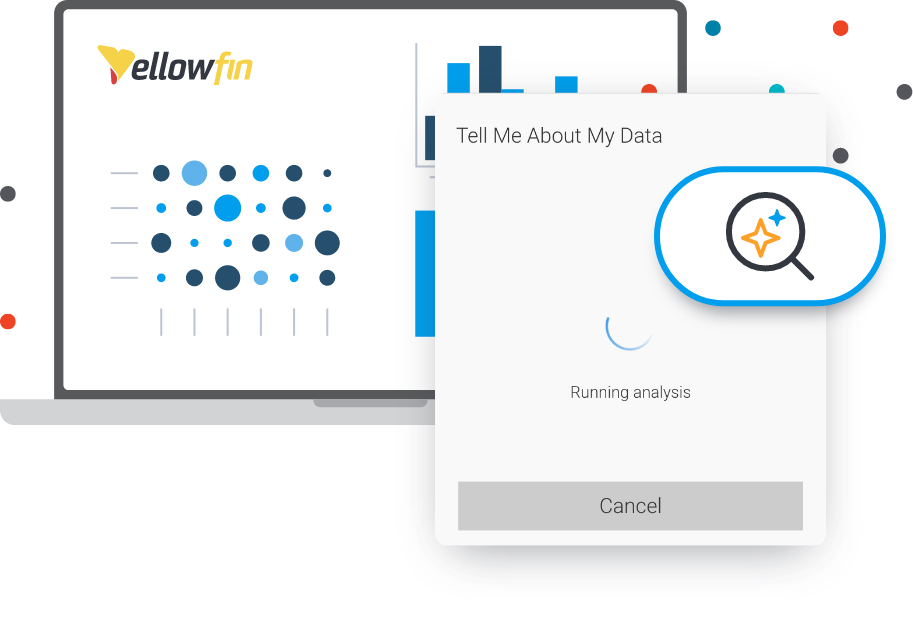
Features like Yellowfin's Tell Me About My Data provide helpful narrative summaries of key insights, effectively acting as an AI-powered data analyst to help you get to the next action much faster.
Conclusion: The future of analytics is fast, and it's AI-powered
In a world where speed is a key differentiator, AI-powered analytics is a necessity, not a luxury.
By automating tedious data tasks, AI empowers your users to make faster, smarter decisions and your product indispensable for your customer base, unlocking significant business impact.
Choosing a solution like Yellowfin BI that offers AI-powered analytics features (see our latest Yellowfin 9.16 feature release highlights) is the first step toward a true data-driven culture and securing your competitive advantage.
The future isn't just about having data, but being able to use AI to make every bit of it count.
Next steps: Explore Yellowfin AI-powered analytics
See Yellowfin’s embedded analytics suite and AI-powered features in action for yourself, and how our BI platform can be tailored to your requirements.